Rethinking OLTP
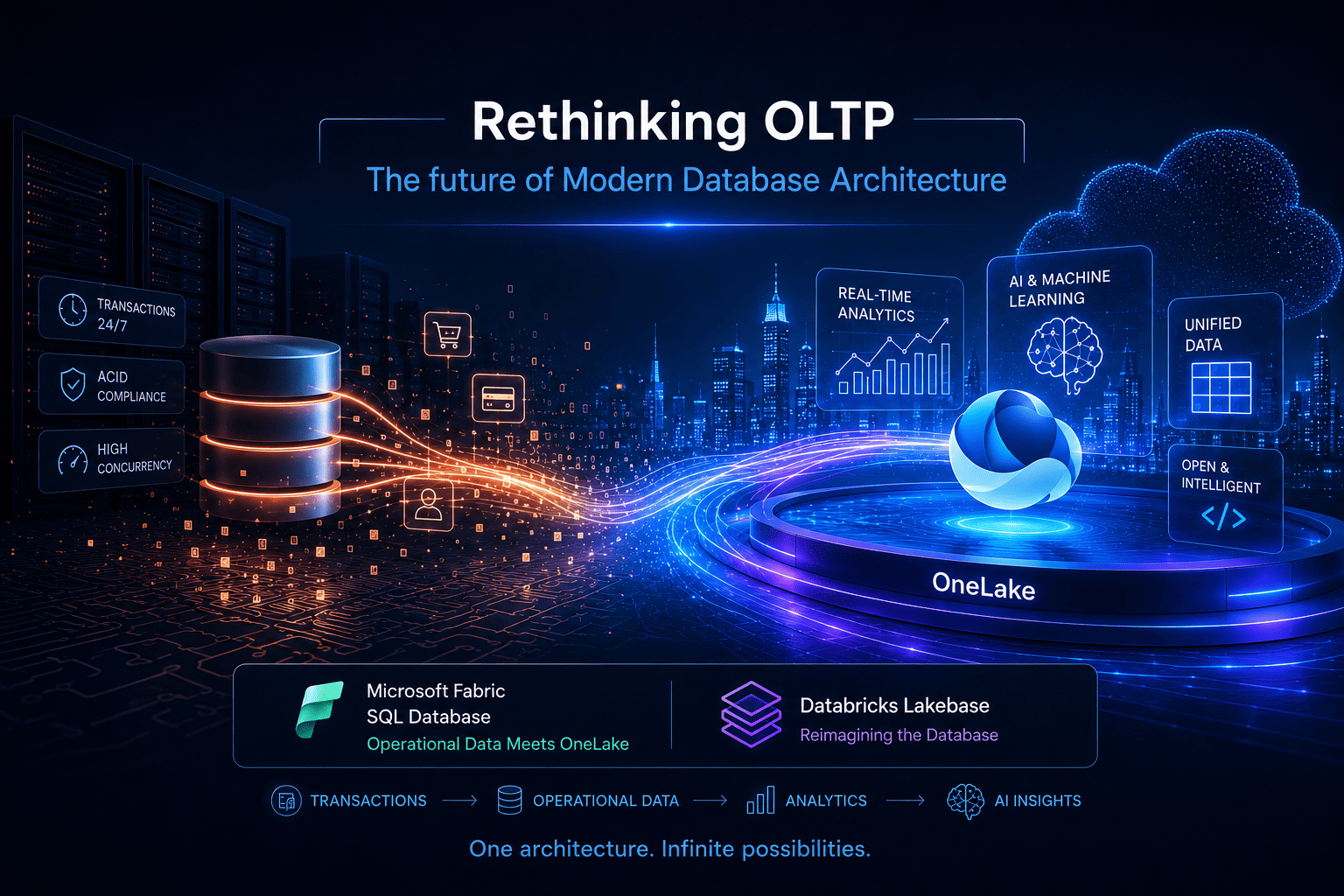
Table of Content
1. The End of Traditional OLTP?
2. The Invisible Cost of Moving Data
3. AI Has Changed the Rules
4. A New Category Is Emerging
5. Microsoft Fabric SQL Database: Operational Data Meets OneLake
6. Databricks Lakebase: Reimagining the Database
7. Different Platforms. Shared Direction.
8. Which Path Fits Your Organization?
9. How do we reduce the architectural distance between transactions, analytics, and AI?
10. What Technology Leaders Should Ask Next
11. Conclusion
The End of Traditional OLTP?
Why Microsoft Fabric SQL Database and Databricks Lakebase Signal a New Era of Enterprise Data Platforms
For more than three decades, enterprise architecture has followed a familiar blueprint.
Applications generated transactions. Operational databases stored them. Data engineers built extraction pipelines. Warehouses prepared the data for reporting. Finally, business intelligence platforms transformed yesterday’s transactions into today’s insights.
The architecture worked remarkably well.
Until artificial intelligence changed the definition of “real time.”
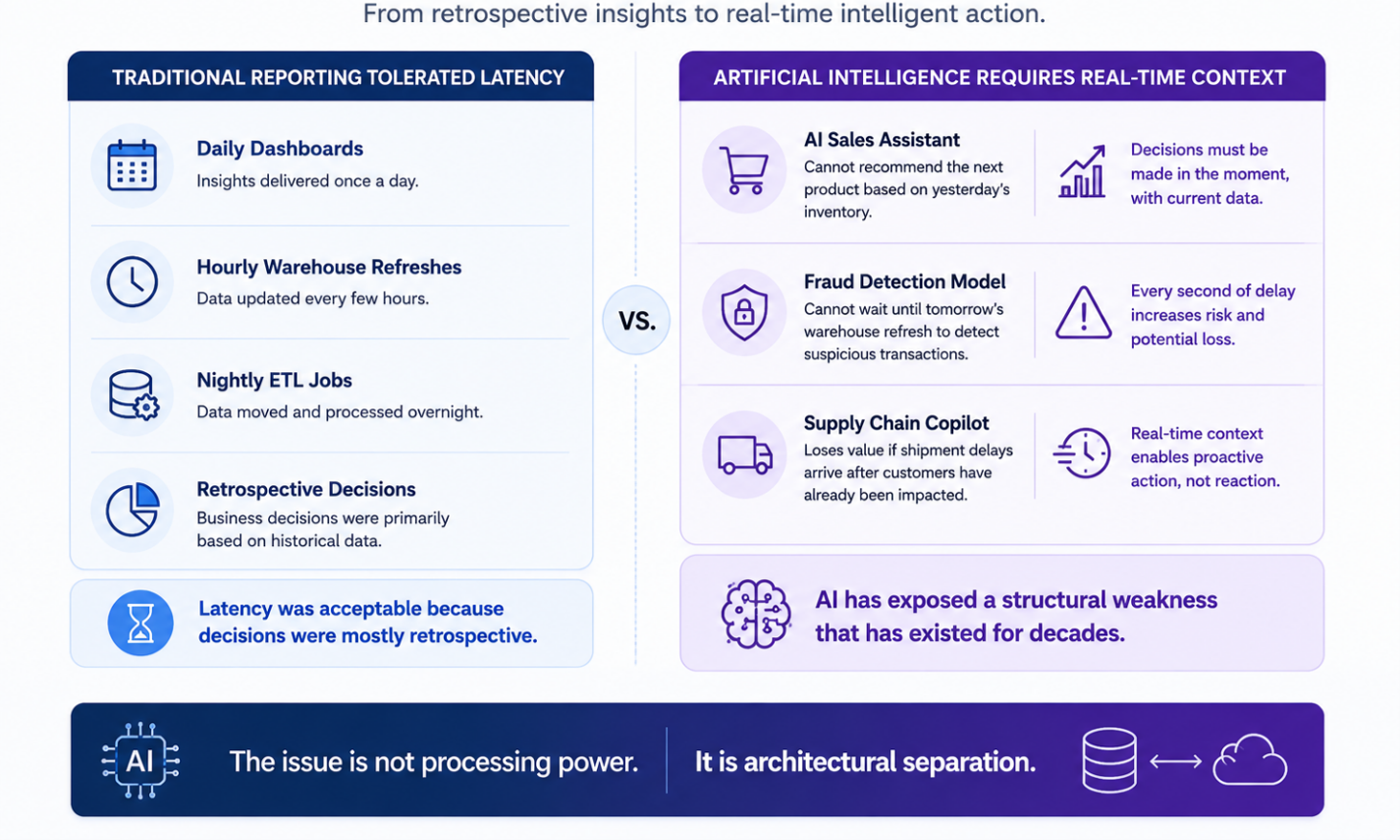
Today’s enterprises expect AI copilots to answer customer questions instantly, fraud detection systems to react within seconds, and recommendation engines to personalize experiences while a transaction is still taking place. Yet many organizations still rely on architectures where operational data travels through multiple pipelines before it becomes available for analytics.
The challenge is no longer the database.
It is the distance between where data is created and where intelligence happens.
That architectural gap has quietly become one of the most expensive layers in the modern data platform.
The Invisible Cost of Moving Data
Every enterprise has invested heavily in operational databases.
Whether running Microsoft SQL Server, Oracle, PostgreSQL, or another transactional engine, these systems remain exceptionally good at what they were designed to do—process high volumes of reliable ACID transactions.
The problem begins immediately after the transaction is committed.
A typical enterprise architecture still resembles something like this.
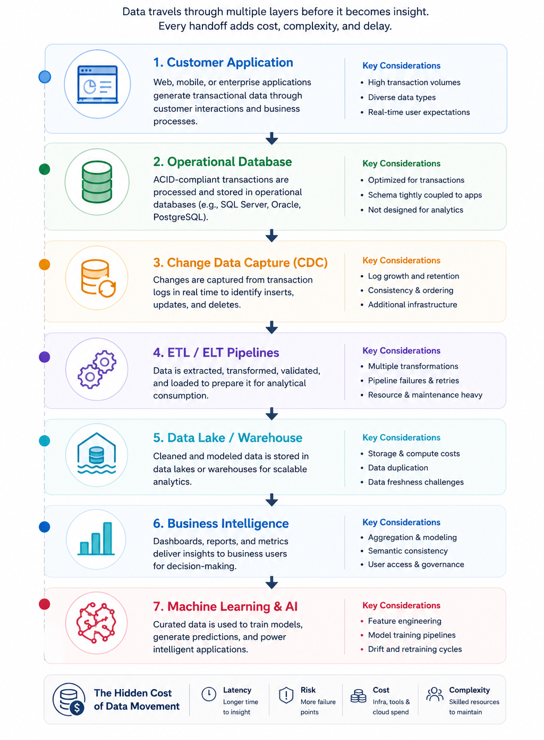
Every additional layer introduces another opportunity for latency, operational failure, security risk, governance complexity, and infrastructure cost.
More importantly, every layer requires engineers to build, monitor, troubleshoot, secure, and continuously maintain systems whose only purpose is moving data from one place to another.
For many organizations, these “data movement” activities have quietly evolved into an industry of their own.
AI Has Changed the Rules
In other words, AI has exposed a structural weakness that has existed for decades.
The issue is not processing power.
It is architectural separation.
A New Category Is Emerging
Interestingly, Microsoft and Databricks—despite taking different technical approaches—are solving the same business problem.
Rather than asking,
“How do we build faster ETL pipelines?”
they are asking something far more disruptive.
“Should these pipelines exist at all?”
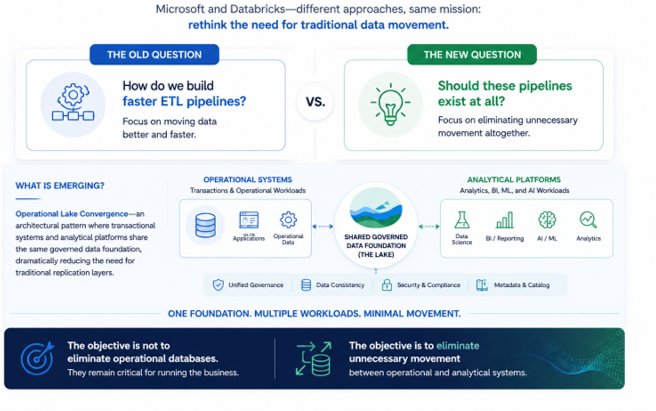
This represents the emergence of what many architects now describe as Operational Lake Convergence—an architectural pattern where transactional systems and analytical platforms share the same governed data foundation, dramatically reducing the need for traditional replication layers.
The objective is not to eliminate operational databases.
It is to eliminate unnecessary movement between operational and analytical systems.
Microsoft Fabric SQL Database: Operational Data Meets OneLake
For organizations invested in the Microsoft ecosystem, Microsoft Fabric SQL Database represents one of the most significant architectural changes since Azure SQL Database was introduced.
Built on the same SQL Database Engine that powers Azure SQL Database, Fabric SQL Database preserves the transactional capabilities developers already trust—full T-SQL compatibility, ACID compliance, and managed operations.
What changes is what happens after the transaction.
Instead of requiring separate replication technologies, supported tables are continuously mirrored into OneLake in Delta format. At the same time, a SQL Analytics Endpoint is automatically created, enabling Spark notebooks, Power BI Direct Lake, SQL analytics, and AI workloads to access operational data without building custom synchronization pipelines.
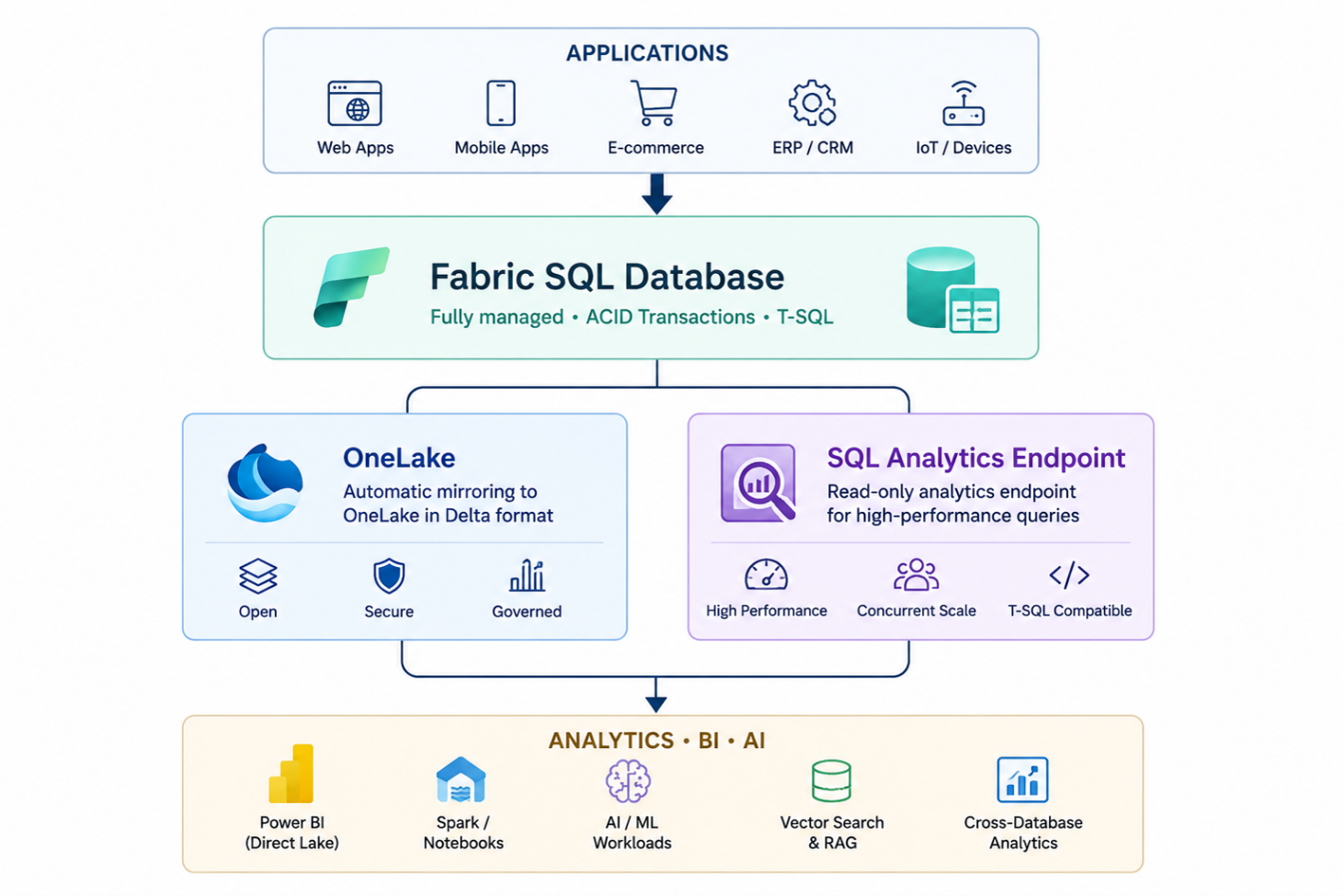
The significance is not simply technical convenience.
It is architectural simplification.
Instead of engineering teams maintaining data synchronization, the platform treats synchronization as a native capability.
That shift allows engineering effort to move away from plumbing and toward business value.
Databricks Lakebase: Reimagining the Database
Databricks approaches the same challenge from a different direction.
Lakebase extends PostgreSQL using cloud-native architecture originally developed by Neon, separating compute entirely from storage.
Rather than treating databases as permanently running servers, compute becomes elastic, serverless, and capable of scaling independently of persistent storage.
Combined with Unity Catalog governance and Delta Lake, operational transactions become immediately available across analytics, machine learning, and AI workloads without conventional CDC infrastructure.
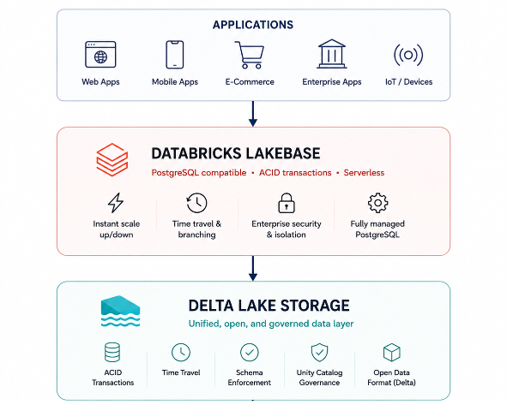
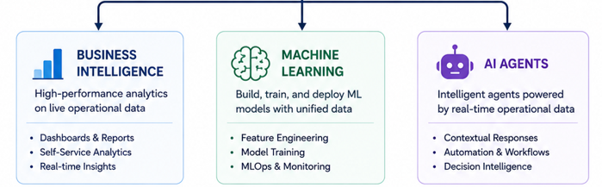
For organizations already operating large Databricks estates, this creates an operational platform where transactional processing, governance, analytics, and AI share a common data foundation.
The traditional boundary between OLTP and OLAP becomes significantly less pronounced.
Different Platforms. Shared Direction.
Although Microsoft Fabric SQL Database and Databricks Lakebase differ in implementation, they point toward the same industry trend.
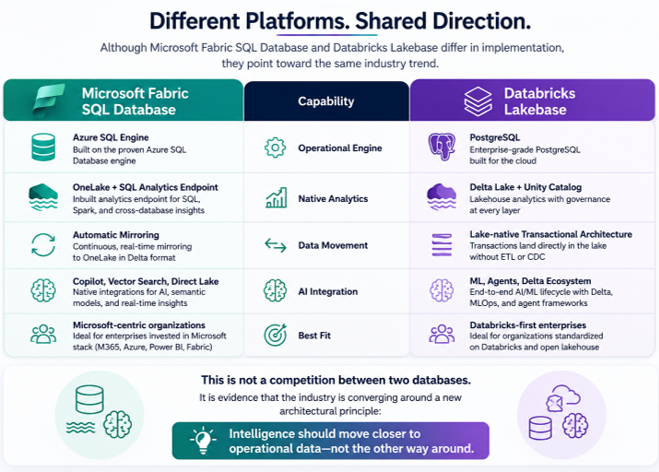
This is not a competition between two databases.
It is evidence that the industry is converging around a new architectural principle:
Intelligence should move closer to operational data—not the other way around.
Which Path Fits Your Organization?
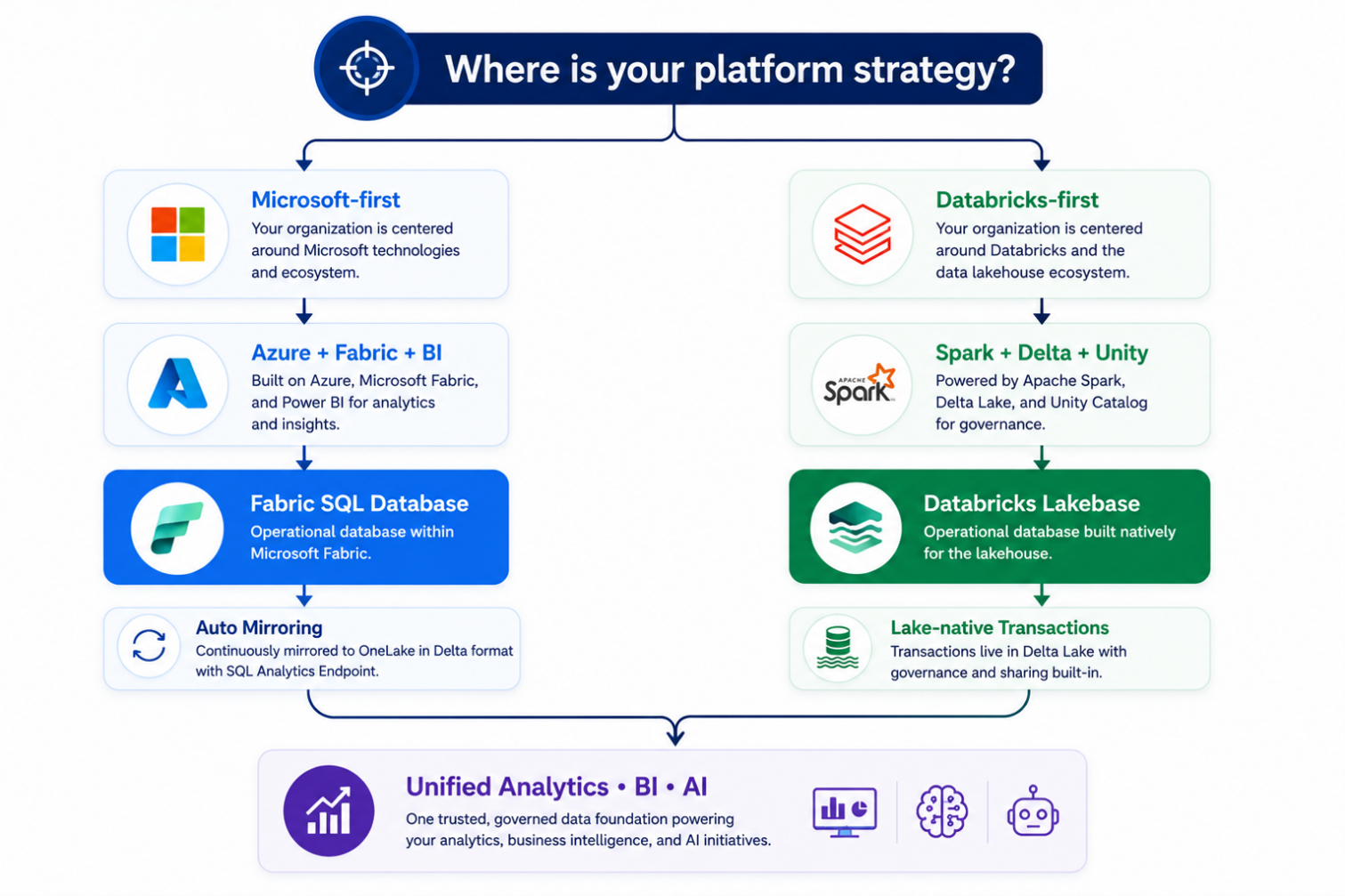
Choosing between Microsoft Fabric SQL Database and Databricks Lakebase is less about selecting a better database and more about aligning with your organization’s existing technology strategy, operating model, and AI ambitions.
How do we reduce the architectural distance between transactions, analytics, and AI?
The answer depends on where your organization’s center of gravity already exists.
- If your business has invested heavily in the Microsoft ecosystem, Fabric SQL Database extends that investment by bringing operational workloads, analytics, and AI onto a unified platform with minimal architectural disruption.
- If your organization is already building data products, machine learning models, and AI applications on the Databricks Lakehouse Platform, Lakebase naturally extends that architecture by introducing operational workloads without creating another replication layer.
What Technology Leaders Should Ask Next
Modernization is no longer about replacing one database with another.
It is about questioning long-standing architectural assumptions.
Technology leaders should begin asking:
- How many of our pipelines exist solely to copy operational data?
- What is the fully loaded cost of maintaining those pipelines?
- How much engineering capacity is spent keeping data synchronized rather than creating new business capabilities?
- How much AI value is delayed because operational data arrives too late?
These questions often reveal that the largest opportunity is not database modernization—it is architectural simplification.
Conclusion: Looking Ahead
The conversation around enterprise data platforms is changing.
For years, success was measured by how efficiently organizations could move data between systems.
The next generation of platforms measures success differently.
How little movement is required at all.
Microsoft Fabric SQL Database and Databricks Lakebase are not signaling the end of operational databases.
They are signaling the end of treating operational and analytical systems as permanently separate worlds.
The organizations that embrace this shift will not simply reduce infrastructure costs or eliminate ETL pipelines.
They will shorten the distance between transaction and insight, giving AI access to the operational context it needs to make decisions when they matter most.
In the coming years, the most valuable data architecture may not be the one with the fastest pipelines.
It may be the one that no longer depends on them.
Blog Author

Quazi Syed Zia Ul Hasan
Software Engineer
Intellify Solutions