RAG VS FINE TUNING
Overview
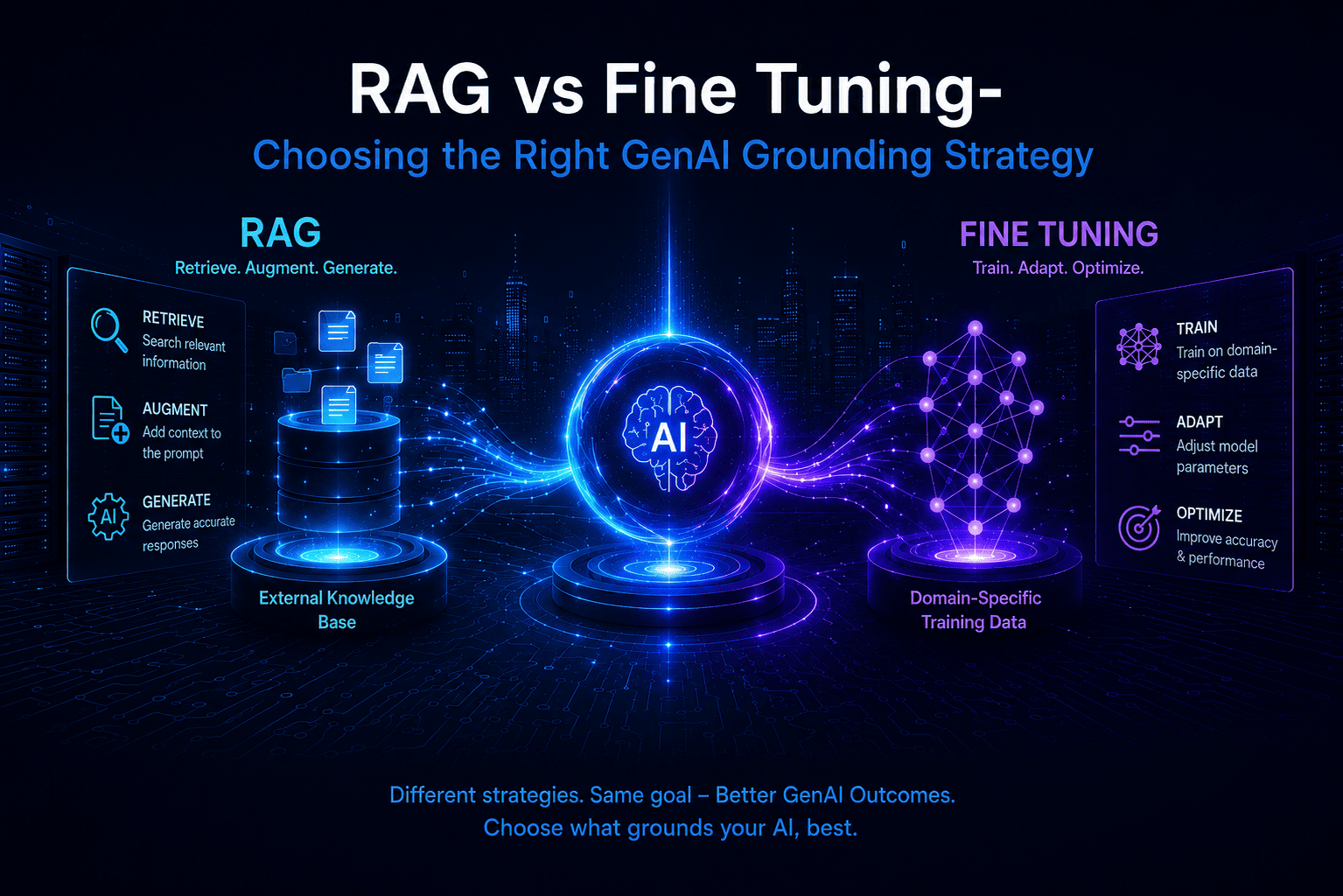
Organizations increasingly want AI assistants that understand their products, policies, and business processes. Two common approaches for adding company-specific knowledge are Retrieval-Augmented Generation (RAG) and fine-tuning. Understanding their strengths and limitations is key to choosing the right strategy.
The Problem in a Nutshell
Models like GPT, Llama, and Claude are trained on vast amounts of public data, making them excellent general-purpose assistants. However, they don’t automatically know your company’s internal documents, product information, policies, customer data, or industry-specific knowledge. To bridge that gap, organizations typically use either RAG or fine-tuning.
Approach 1: RAG (Look It Up First)
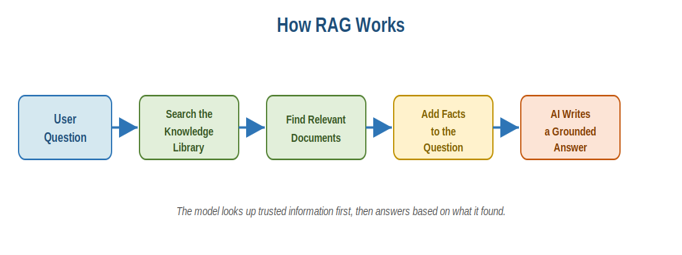
RAG stands for Retrieval-Augmented Generation, but you can think of it as giving the AI an open-book exam. Instead of expecting it to memorize everything, you let it look up the right information now a question is asked, and then write its answer based on what it found.
What’s Happening Behind the Scenes
A RAG system works in two steps: first, it retrieves the most relevant information using semantic search, which finds content based on meaning rather than keywords. It then provides that information to the AI, which generates a response grounded in the retrieved documents.
Why People Like RAG
- Always current: add a new document and the assistant can use it right away, no retraining required.
- Affordable to start there’s no costly training step.
- Shows its work: answers can point back to the source document they came from.
- Stays grounded: because it answers from real documents, it’s far less likely to make things up.
- Keeps data private: your sensitive information stays in your own secured database with access controls, rather than being baked into the model.
The Trade-Offs
- RAG requires infrastructure to store, index, and retrieve documents.
- Response quality depends on the quality of the underlying content and retrieval process; poor or irrelevant documents lead to poor answers.
- Retrieving information adds some latency and requires proper access controls to protect sensitive data.
Approach 2: Fine-Tuning (Teach It by Heart)
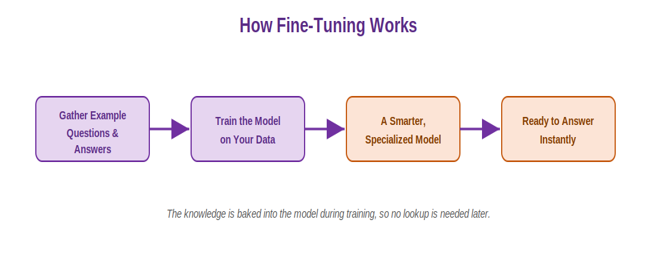
Fine-tuning is more like sending the AI to school. You take a model and continue training it on your own examples until your terminology, style, and way of doing things become second nature. The knowledge gets built into the model itself, so it doesn’t need to look anything up later.
The Three Steps of Fine-Tuning
Fine-tuning involves three steps: collecting high-quality training examples, training the model on those examples, and validating its performance. The better the training data reflects your real-world use case, the better the results.
The Trade-Offs
- Fine-tuning requires a high-quality training dataset, which can be time-consuming and costly to prepare.
- Training consumes significant computational resources, and updating knowledge typically requires retraining the model.
- Poorly designed training data can reduce model performance, causing overfitting or loss of some general capabilities.
A quick analogyThink of fine-tuning like a doctor who specializes for years in one field. They become brilliant in that area, but they may get a little rusty at general conversation outside it. RAG, by contrast, is like a sharp generalist with an excellent reference library always within reach. |
Side-by-Side: How They Compare
Here’s a quick way to see the differences briefly:
|
What matters to you |
RAG |
Fine-Tuning |
|
Updating knowledge |
Instant, just add a file |
Needs retraining |
|
Setup complexity |
Higher |
Lower once it’s running |
|
Cost to get started |
Low |
Medium to high |
|
Cost per answer |
Higher (it looks things up) |
Lower |
|
Can show its sources |
Yes |
Not really |
|
Handles changing info |
Excellent |
Poor |
|
Custom tone & behaviour |
Limited |
Excellent |
|
Keeps answers grounded |
Strong |
Moderate |
|
How you maintain it |
Update documents |
Retrain the model |
When RAG Is the Right Call
Reach for RAG when your information changes often and being current matters most. It’s a great fit for:
- Internal company assistants that answer from policies and manuals
- Customer support bots that need the latest product details
- Compliance settings where the rules keep changing
- Software platforms where every customer has their own data
When Fine-Tuning Is the Right Call
Choose fine-tuning when how the AI behaves matters more than keeping a constantly changing knowledge base. It works well for:
- Tasks that must follow a strict format every time
- Fields with heavy specialized language, like medicine, law, or finance
- Structured jobs such as reading invoices or classifying documents
- Customer-facing writing that needs to stay on-brand
The Best Answer Is Often Both
Here’s the part many people miss: you don’t have to pick just one. In practice, the strongest assistants combine the two. Fine-tuning shapes how the assistant behaves, while RAG keeps it informed with the latest facts.
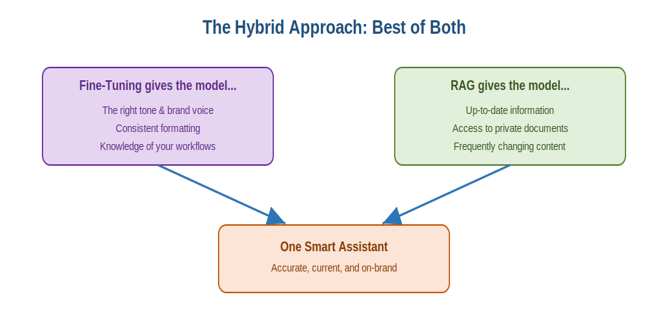
Studies have generally found that pairing the two delivers better results than either one alone, since each covers the other’s weak spot.
There’s even a name for it: RAFTThis hybrid approach is sometimes called RAFT, Retrieval-Augmented Fine-Tuning. The idea is simple: you fine-tune a model so it deeply understands your field, then deploy it in a RAG setup so it can also pull in the freshest information. You get answers that are both expert and up to date. |
A Real-World Example
Imagine a manufacturing company building an AI assistant for its support team.
With fine-tuning only, the assistant learns the company’s terminology and common troubleshooting steps, but it has no idea about products released after its training.
With RAG only, it can pull up the newest product manuals, but its answers may not follow the company’s preferred style.
With both together, the assistant understands the lingo, follows company guidelines, and pulls in the latest product information, giving customers accurate, consistent, up-to-date help.
Building a Hybrid System in Practice
Combining the two approaches sounds great, but how does it work, day-to-day? The key idea is that not every question needs the same treatment. Some questions are best answered from what the model already knows, while others need a fresh look up. A well-built hybrid assistant decides which is which.
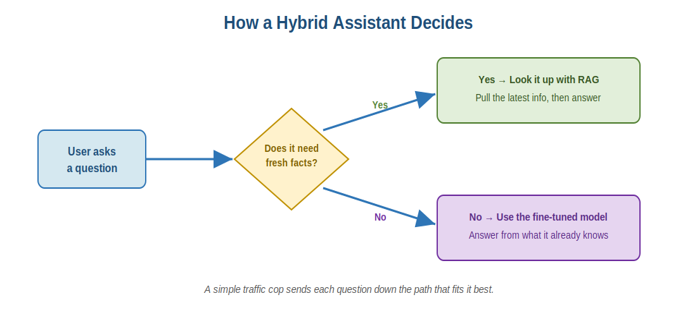
Think of it like a helpful traffic cop sitting at the front door. When a question arrives, it asks a simple thing: does answering this need up-to-the-minute or document-specific information? If yes, the question goes through the RAG path, and the system looks things up before replying. If no, say it’s a routine question about how to phrase something, the fine-tuned model handles it directly.
Two Things to Get Right
The first is the decision rule. You need a sensible way to decide which questions get a look up and which don’t. This can be a set of simple rules or a small “classifier” that learns to sort questions. Getting this right keeps the assistant both fast and accurate.
The second is keeping the two halves in sync. Your fine-tuned model and your document library both describe how your business works, so they need to agree. If the model was trained on last year’s process while the document library has this year’s, the assistant can give confusing, contradictory answers. Keeping both up to date is an ongoing housekeeping task, not a one-time setup.
A Simple Decision Guide
Choose RAG if:
- Your information changes frequently
- You want answers that can cite their sources
- You need to update knowledge quickly
- Your budget for training is limited
Choose Fine-Tuning if:
- Shaping the AI’s behaviour is your main goal
- Consistent output is critical
- You have good training examples ready
- Your knowledge rarely changes
Choose Both if:
- You need current information and a specialized style
- You’re building a serious, enterprise-grade assistant
Conclusion
RAG and fine-tuning aren’t rivals; they solve different problems. RAG keeps your AI current, factual, and able to show its sources. Fine-tuning shapes how your AI behaves and makes it sharper at specific tasks.
For most real-world business uses, the smartest move is to blend them. Once you understand the trade-offs and match them to what your business needs, you can build an AI assistant that’s accurate, dependable, and easy to maintain.
Blog Author

Ankit Shrivastava
Senior Software Engineer
Intellify Solutions