Data Mesh Architecture: Decentralizing Ownership Without Losing Control
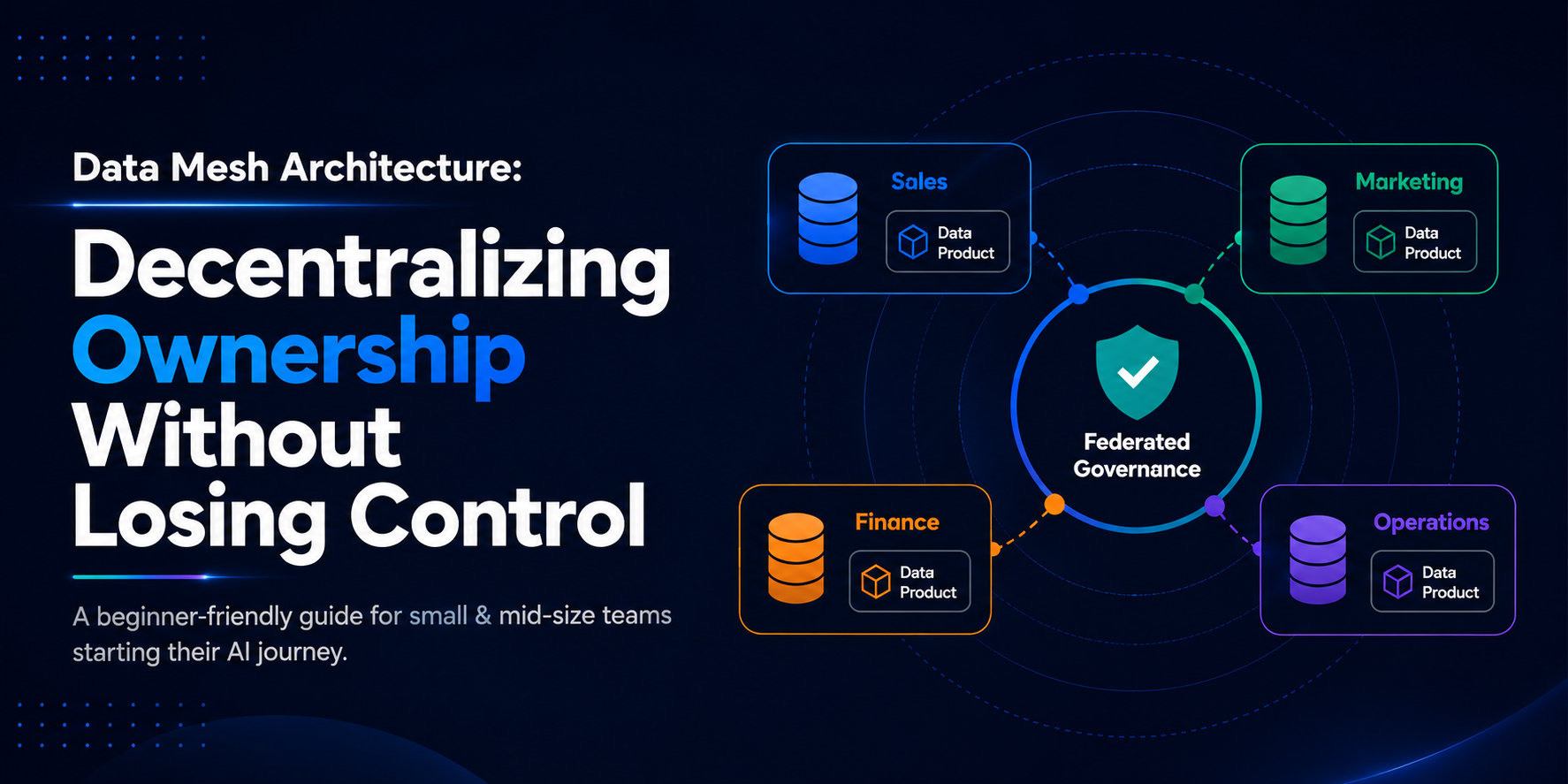
Table of Content
Why Centralized Data Can Become a Bottleneck ?
The Central Data Team Doesn’t Disappear
“Decentralized” Doesn’t Mean “Wild West”
When Data Mesh Fits and When to Wait
What a Data Product Looks Like
Platform Capability Prerequisites
How to Get Started (Without Boiling the Ocean)
Trade-offs and Common Pitfalls
Introduction
Your AI projects are only as good as the data feeding them.
And if you are a small or mid-size business just starting your AI journey, you have probably already hit the wall: one overloaded data team, a queue of requests a mile long, and “where is that report?” emails flying around.
Data mesh is one approach that can help address these scaling challenges.
This post breaks down what it is, why it matters for AI-readiness, and how to adopt it without losing control of your data. No jargon overload, promise.
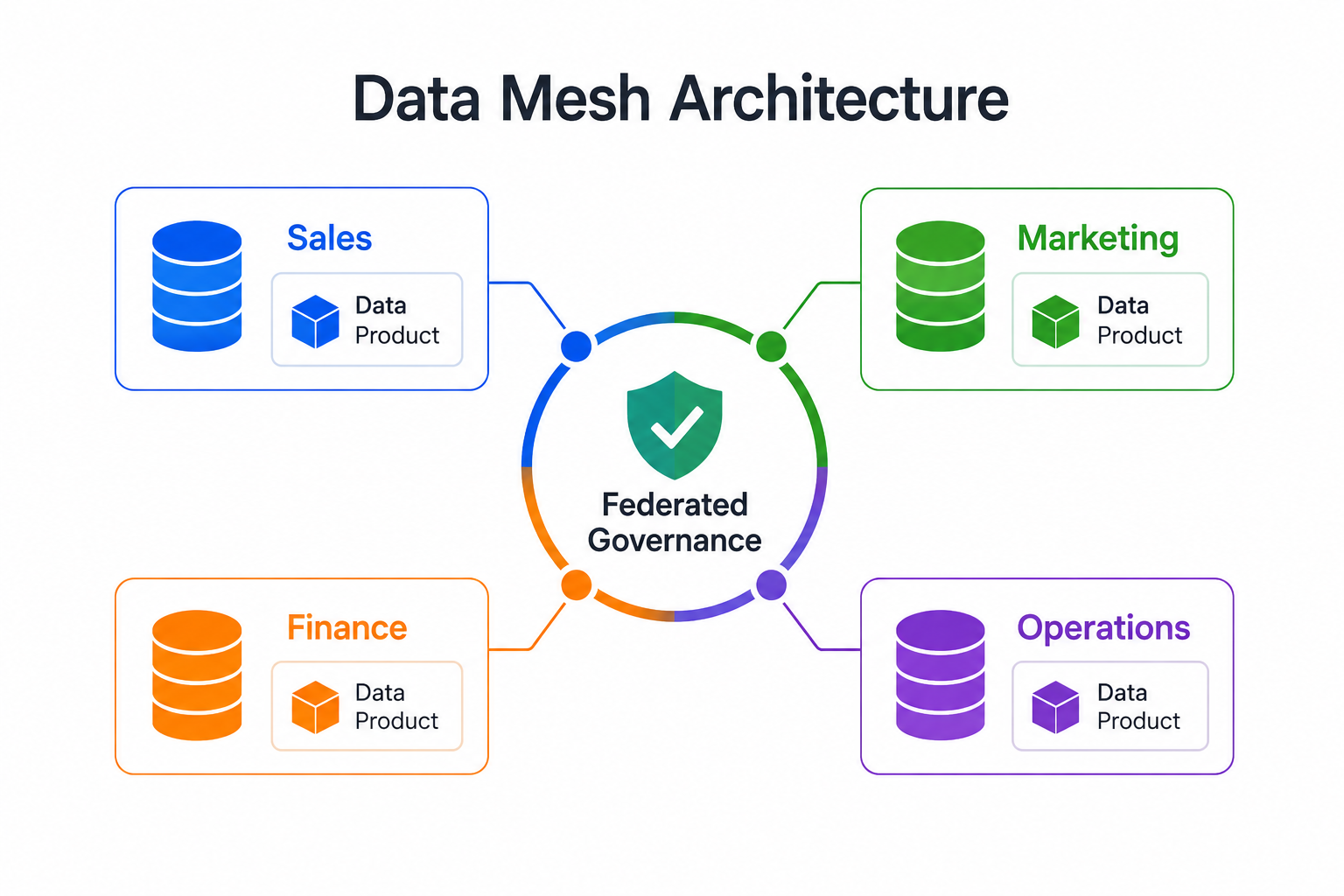
Figure 1: Data mesh – domain teams own their data, connected by shared federated governance.
What Is Data Mesh ?
Think of the old way as one giant warehouse where every team dumps its data and then waits in line to get anything back. It works until it doesn’t.
Data mesh, a term coined by Zhamak Dehghani (see “Data Mesh Principles and Logical Architecture,” martinfowler.com), flips that model. Instead of one central team owning all the data, the teams closest to the data own it. Sales owns sales data. Marketing owns marketing data. Each team serves its data to the rest of the company like a polished product.
The goal is to decentralize data ownership with shared rules, allowing organizations to balance domain autonomy with common governance. One thing to make clear up front: data mesh is as much an organizational shift as a technical one Dehghani and ThoughtWorks describe it as a sociotechnical approach and it is one option among several, not a database you buy or a guarantee of AI success.
Why Centralized Data Can Become a Bottleneck ?
Here is the bottleneck most growing companies recognize instantly.
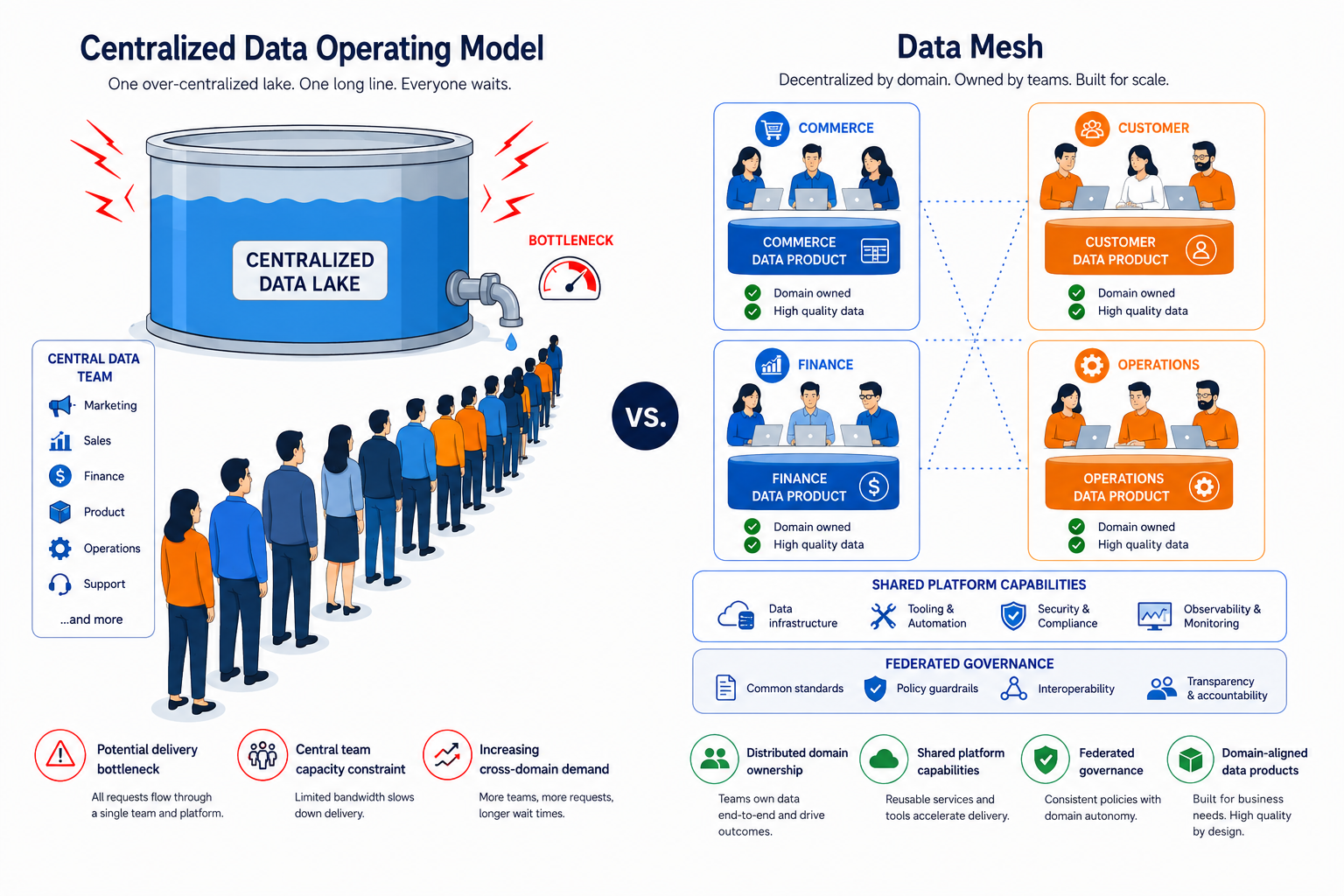
Figure 2: A centralized data lake creates queues and bottlenecks; data mesh distributes ownership.
The labels in this diagram are illustrative. A centralized model is not inherently a single point of failure, nor is it always hard to scale the practical issue is that one team can become a capacity bottleneck as demand grows.
A centralized data operating model is not inherently bad it can work well when an organization is small and its data is simple. But as domains, consumers, and AI use cases multiply, a single central team can struggle to keep up. Common symptoms:
- Slow delivery: In some centralized operating models, dashboards and models compete for capacity in a shared delivery queue.
- Lost context: A central team rarely understands why the data behaves the way it does.
- Capacity becomes the constraint: when demand grows faster than the team can absorb, the central team becomes an organizational bottleneck. Frustrated teams may even spin up their own shadow data projects, fragmenting the data you are trying to unify.
For AI, delivery speed and data trust matter a great deal. Machine learning needs clean, well-understood, AI-ready data delivered reliably. A bottleneck can stall momentum before your first model ships though data mesh is not the only way to relieve one, and it brings trade-offs of its own.
The 4 Principles of Data Mesh
Data mesh rests on four foundational principles defined by Zhamak Dehghani (“Data Mesh Principles and Logical Architecture,” martinfowler.com). You do not need all of them on day one, but knowing them gives you a map.
- Domain ownership – Ownership is domain-oriented: the business domain most responsible for a set of data owns and serves it end to end which is usually, but not always, the team that generates it.
- Data as a product – Data is treated like a real product: documented, reliable, and easy for others to use. Good data products also ship with documentation, quality expectations, and clear ownership so consumers can trust them.
- Self-serve data platform – Shared tooling so teams can publish and find data without writing everything from scratch.
- Federated computational governance – Central rules, decentralized execution. Standards are defined once and, where practical, encoded into the platform so they are applied consistently.
That fourth principle is the secret sauce. It is how you decentralize ownership without losing control.
The Central Data Team Doesn’t Disappear
A common misconception is that data mesh eliminates the central data team. It doesn’t the role evolves. Instead of fulfilling every data request, the central team increasingly focuses on enabling the domains: building and running the self-serve platform, defining and maintaining governance standards, and providing shared capabilities for security, observability, and developer experience so each domain isn’t reinventing them.
“Decentralized” Doesn’t Mean “Wild West”
This is the fear every leader has: if everyone owns their own data, won’t it become chaos?
Not if you set guardrails. Federated governance means a small group defines the non-negotiables (security, privacy, naming standards, quality checks) and those rules are baked into the platform itself.
• Teams move fast within clear boundaries.
• Governance policies can be standardized and, where appropriate, automated in the platform. This helps apply consistent controls, but it does not by itself make you GDPR or HIPAA-compliant regulatory compliance still requires organizational processes, accountability, and the right technical and administrative controls.
• Everyone speaks the same data “language,” so products plug together cleanly.
It is the difference between a city with traffic laws and a city with no roads at all.
An Illustrative Example
The following is a hypothetical scenario for illustration, not a real customer or a measured result. Imagine “BrightCart,” a mid-size online retailer starting its AI journey.
Previously, a small central data team handled every request, and a simple customer-segment report could sit in the queue for a while. An AI-based product recommender stalled partly because teams did not fully trust the underlying data.
Suppose BrightCart adopts a lightweight data mesh:
- Marketing publishes a “Customer Segments” data product, refreshed on a schedule and documented in plain language.
- Sales owns an “Orders” data product with built-in quality checks.
- The central team shifts from doing all the work to maintaining the self-serve platform and governance rules.
With this operating model in place, BrightCart could potentially reduce its dependence on the central team and give its AI teams more accessible, trusted data products to build on. Whether that happens and how quickly depends on execution, data quality, and organizational readiness. This illustrates the intended direction of change, not a promised outcome.
When Data Mesh Fits and When to Wait
Honest answer: not always. Data mesh tends to become more compelling as complexity rises.
Good signs you are ready:
- Multiple teams constantly request data and wait too long.
- Your single data team is drowning.
- You are scaling AI or analytics across departments.
- Each domain has enough engineering capacity to genuinely own its data products.
Maybe wait if:
- You are a tiny team with one simple database. A central setup may be plenty for now.
Start where the pain is. You do not need a full transformation to benefit from the thinking.
What a Data Product Looks Like
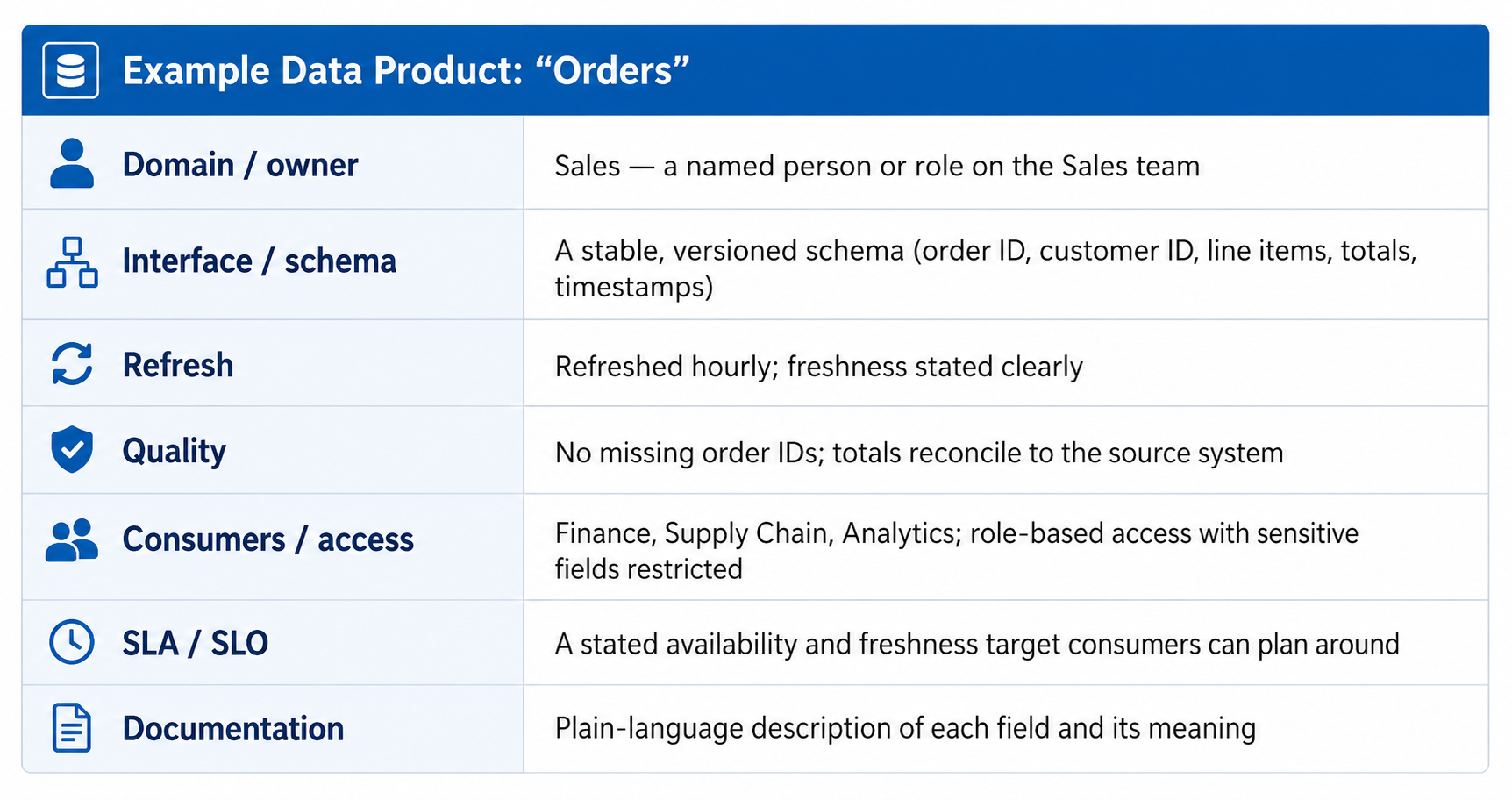
“Data as a product” stays abstract until you see one. A data product is more than a table it is packaged so others can find it, trust it, and use it safely. Here is a small, illustrative example.
# Illustrative data product contract
name: orders_data_product
version: 1
owner: sales-data-team
sla:
freshness_hours: 1
columns:
– name: order_id
type: string
required: true
unique: true
– name: total_amount
type: decimal
required: true
This is an illustrative, tool-agnostic contract rather than a vendor-specific configuration file. In practice, these expectations can be implemented using platform-native capabilities or tools such as dbt, Soda, or other data-contract/testing frameworks.
The goal isn’t to implement every capability on day one it’s to make each product discoverable, owned, documented, reasonably reliable, and clear about who it serves.
Platform Capability Prerequisites
Self-serve doesn’t mean “no platform.” For domains to own data products without chaos, a few shared capabilities need to exist — you can start lightweight and mature them over time:
- Catalog and discoverability: a place where consumers can find data products and understand what they contain (e.g., Microsoft Purview, Atlan, DataHub).
- Access and policy enforcement: consistent authentication, authorization, and data-classification controls (e.g., Databricks Unity Catalog, AWS Lake Formation, Microsoft Fabric Domains).
- Quality and contracts: agreed schemas or data contracts plus quality checks, so consumers know what to expect (e.g., dbt tests, Soda, Great Expectations).
- Lineage: visibility into where data came from and how it was transformed (e.g., OpenLineage, Microsoft Purview).
- Monitoring: freshness, reliability, and usage signals so problems surface early (e.g., Monte Carlo, Datadog).
How to Get Started (Without Boiling the Ocean)
You can adopt data mesh gradually. Here is a sensible first path:
- Pick one domain. Choose a team that already feels the data pain most.
- Build one data product. Make it documented, reliable, and genuinely useful to others.
- Define minimal governance. Agree on a handful of rules: naming, access, and quality.
- Add self-serve tooling. Use existing cloud platforms before building anything custom.
- Measure and expand. Did delivery speed up? Roll the pattern out to the next domain.
This crawl-walk-run approach keeps risk low and builds internal trust, which matters more than any tool.
Pragmatic Note for Growing Teams: You do not need multiple cloud accounts or physically separate platforms to get started. A practical starting point is to establish domain-based ownership, logical workspaces or schemas, data products, and federated governance on a shared platform before considering more physically distributed infrastructure. Platforms such as Microsoft Fabric, Databricks, or Snowflake can provide capabilities that support this type of logical organization. This is a pragmatic adoption pattern, not one of the four canonical data-mesh principles Dehghani’s own writing notes that storage can remain centralized while domain ownership is decentralized.
Trade-offs and Common Pitfalls
Data mesh moves responsibility closer to the domains; it does not make data management disappear. Weigh the costs before adopting:
- Engineering cost: domain teams take on data-product work they may not be staffed or skilled for.
- Cross-domain complexity: shared definitions and data that spans domains can be genuinely hard to reconcile.
- Duplication and cost: without a real shared platform, teams can duplicate tooling and drive up cost.
- Organizational change: this is a shift in ownership and accountability, not just a technical rollout, and it needs leadership support.
The Payoff for Your AI Journey
For organizations beginning to weave AI into daily workflows, data democratization is the unlock. When every team owns trustworthy, discoverable data products, your AI initiatives stop starving for good data. That said, data mesh does not automatically make an organization AI-ready readiness also depends on data quality, lineage, security, integration, infrastructure, and your models’ requirements. Treat it as one potential foundation, not a guarantee.
Data mesh is not just an architecture trend. It is one way to build toward a scalable data foundation that can better support AI initiatives.
Start small, set clear guardrails, and let your domains lead. Your future models, and your data team’s sanity, will thank you.
Want to go deeper?
- How to Move Beyond a Monolithic Data Lake to a Distributed Data Mesh – Zhamak Dehghani, 2019.
- Data Mesh Principles and Logical Architecture – Zhamak Dehghani, 2020.
- Data Mesh: Delivering Data-Driven Value at Scale – Thoughtworks/O’Reilly, 2022.
Blog Author

Rahul Meshram
Lead Engineer
Intellify Solutions