MLOps Maturity Model
Where Does Your Organization Stand?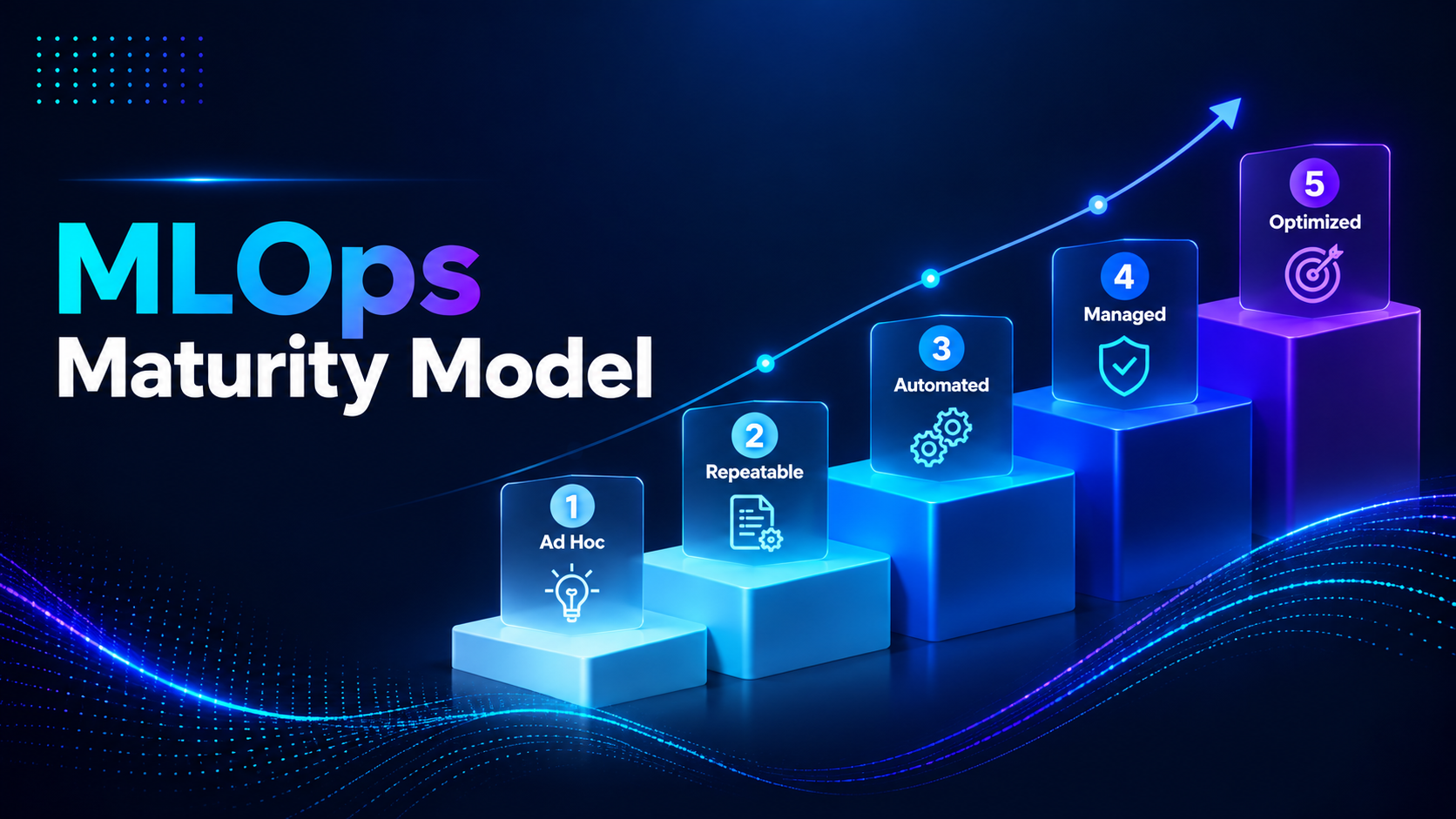
Table of Content
1. Introduction-What is MLOps Maturity Model
3. Why MLOps Maturity Matters ?
4. The Five Levels of MLOps Maturity
5. Real-World Example: Healthcare Organization’s Journey
6. MLOps Maturity Assessment Checklist
8. Common Signs Your Organization Needs Better MLOps
Introduction: What is MLOps Maturity Model ?
The MLOps Maturity Model helps organizations assess and improve how they build, deploy, monitor, and manage machine learning models. Commonly represented as a five-level framework, it ranges from ad hoc experimentation to fully automated, enterprise-scale AI operations, providing a roadmap for advancing MLOps capabilities. It brings together Machine Learning, DevOps, Data Engineering, and Governance into a unified operating model.
Who This Blog Is For ?
This blog is for professionals building, scaling, or governing AI and ML systems:
-
- Data Science and ML Leaders looking to establish reliable, repeatable production workflows
- Technology and Digital Transformation Leaders seeking to assess AI readiness and guide investments
- MLOps and DevOps Engineers responsible for deployment, monitoring, and operationalizing ML model
- Product Managers and Business Analysts who understand how operational maturity impacts AI success
Whether you’re starting your AI journey or scaling existing initiatives, this framework provides practical guidance for improving reliability, scalability, and governance.
Why MLOps Maturity Matters ?
Most AI projects fail not because models lack accuracy, but because they never make it out of the sandbox. If your team is manually moving files to production, wrestling with inconsistent environments, or wondering why that model is suddenly underperforming, you’re experiencing the MLOps Gap.
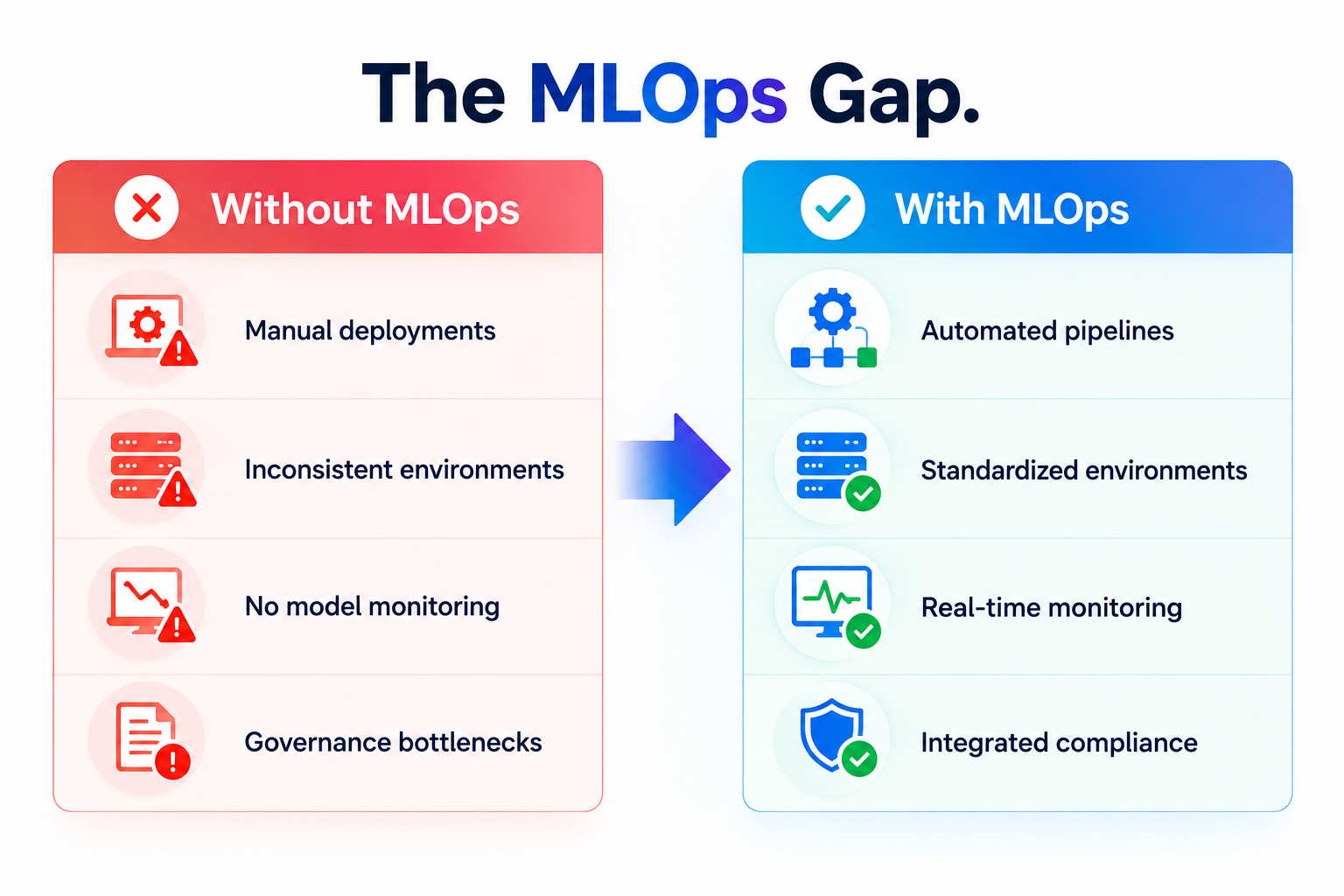
Building a machine learning model is a technical achievement but scaling it into business value is the real challenge.
As organizations move from a few AI pilots to a portfolio of AI solutions, they face critical questions:
- How quickly can new models be deployed?
- How effectively can they be monitored and maintained?
- How efficiently can teams collaborate?
- How can model drift, governance, security, and compliance be managed at scale?
A mature MLOps practice helps organizations:
- Identify operational bottlenecks and eliminate inefficiencies
- Standardize and automate ML workflows across teams
- Improve reliability, governance, scalability, and time-to-market
- Accelerate the transition from experimentation to enterprise-scale AI
The Five Levels of MLOps Maturity
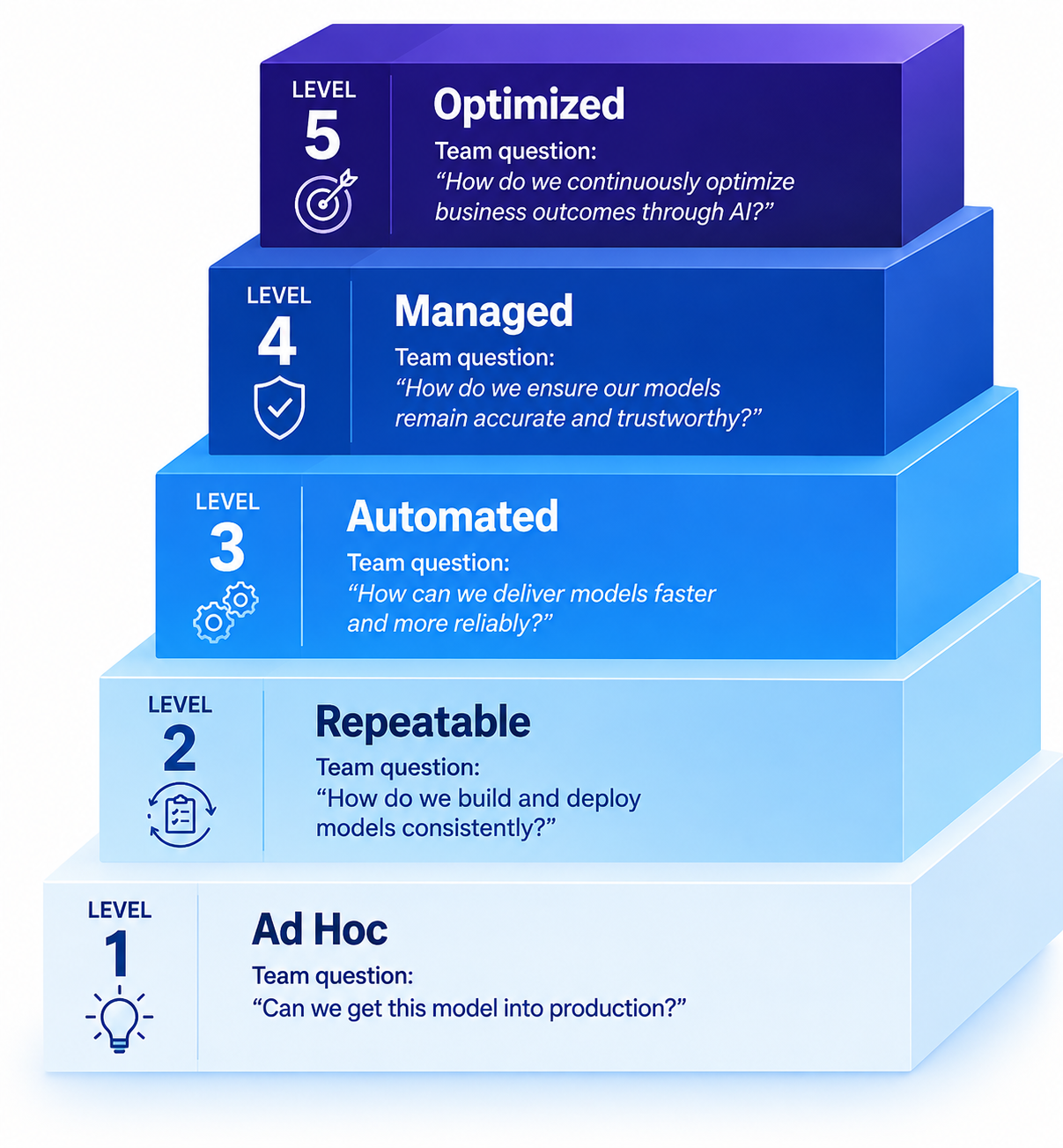
Level 1: Ad Hoc / Experimental
Characteristics:
- Models developed on local machines
- Manual data preparation with no version control
- No standardized workflows or documentation
- Model deployment is rare or entirely manual
Benefits: Difficulty reproducing results, strong individual dependency, and unpredictable deployment cycles.
Level 2: Repeatable
Characteristics:
- Version control for code
- Shared development environments
- Basic CI/CD practices emerging
- Standardized data pipelines and experiment tracking
Benefits: Improved collaboration, reproducibility, reduced deployment risks, and ability to share and reuse work.
Level 3: Automated
Characteristics:
- Automated training pipelines
- Automated testing and validation
- CI/CD for ML models
- Model registry and Infrastructure as Code
Benefits: Faster, more reliable deployments, reduced manual effort, and consistent model quality at each release.
Level 4: Managed
Characteristics:
- Continuous model monitoring in production
- Automated retraining workflows
- Model performance tracking and alerting
- Data and concept drift detection
- Governance controls integrated into workflows
Benefits: Stable production performance, improved lifecycle management, and strong alignment with business goals.
Level 5: Optimized / AI at Scale
Characteristics:
- End-to-end automation across the ML lifecycle
- Self-service ML platforms for all teams
- Enterprise governance and explainability frameworks
- Responsible AI practices
- Cross-functional collaboration at scale
- Continuous optimization driven by business feedback
Benefits: Rapid innovation with low overhead, enterprise-scale adoption, and strong compliance and governance posture.
Real-World Example: Healthcare Organization’s Journey
Consider a healthcare provider building patient risk prediction models as they progress through maturity levels. This progression reflects challenges and milestones that teams across every sector will recognize:
-
- Level 1 – Ad Hoc: Data scientists develop models in local notebooks. Results are promising but impossible to reproduce reliably, and moving anything to production requires heroic manual effort and cross-functional coordination.
- Level 2 – Repeatable: As adoption grows, the team introduces MLflow for experiment tracking. Model runs are logged, results can be compared, and the team eliminates wheel-reinvention with every new project.
- Level 3 – Automated: Deployments are automated through CI/CD pipelines. What once took days of manual coordination now happens through validated, repeatable processes, freeing teams to focus on model quality.
- Level 4 – Managed: Model drift monitoring is implemented. When patient risk predictions begin to diverge from real-world outcomes—perhaps due to seasonal demographic shifts—the system detects it automatically and triggers retraining.
- Level 5 – Optimized: Clinical teams use self-service AI capabilities. They request new risk models, track performance, and act on AI-driven insights without filing tickets to the data science team.
MLOps Maturity Assessment Checklist
Answer these questions honestly to assess your current maturity level. Count your “Yes” answers to determine where your organization stands.
| Assessment Question | Yes/No |
|---|---|
| Is data versioned and traceable throughout the ML lifecycle? | |
| Are data quality checks automated and consistently enforced? | |
| Can datasets be reproduced on demand for retraining and auditing? | |
| Are experiments tracked systematically with metrics and parameters? | |
| Is model code maintained in a version control system? | |
| Are training environments standardized and reproducible? | |
| Is model deployment automated through CI/CD pipelines? | |
| Are rollback mechanisms available for failed deployments? | |
| Are models deployed consistently across environments? | |
| Is model performance monitored in production? | |
| Can data drift or concept drift be detected automatically? | |
| Are alerts generated when performance thresholds are breached? | |
| Are model predictions explainable and transparent? | |
| Is audit information maintained for every deployment? | |
| Are regulatory and compliance requirements integrated into workflows? |
How to Score Your Results
Count your “Yes” answers to identify your maturity level:
-
-
- 0–3 “Yes” answers → Level 1 (Ad Hoc / Experimental)
- 4–6 “Yes” answers → Level 2 (Repeatable)
- 7–9 “Yes” answers → Level 3 (Automated)
- 10–12 “Yes” answers → Level 4 (Managed)
- 13–15 “Yes” answers → Level 5 (Optimized / AI at Scale)
-
Common Signs Your Organization Needs Better MLOps
These aren’t failures of talent they indicate process gaps and suggest your technology has outgrown your current operating model:
-
-
- “It Works on My Machine” Syndrome: Data scientists spend more time fixing environment issues than building models. Production deployments feel high-risk and all-hands-on-deck.
- “Black Box” Problem: When performance dips, teams dig through logs for days without visibility into whether the issue is data, code, or external changes.
- “Governance Wall”: Security and compliance reviews stall every release, effectively killing your team’s agility and preventing rapid iteration.
- “One-and-Done” Cycle: Models deploy once and are forgotten. They’re never retrained, gradually lose accuracy, and eventually become useless.
-
Building Your MLOps Roadmap
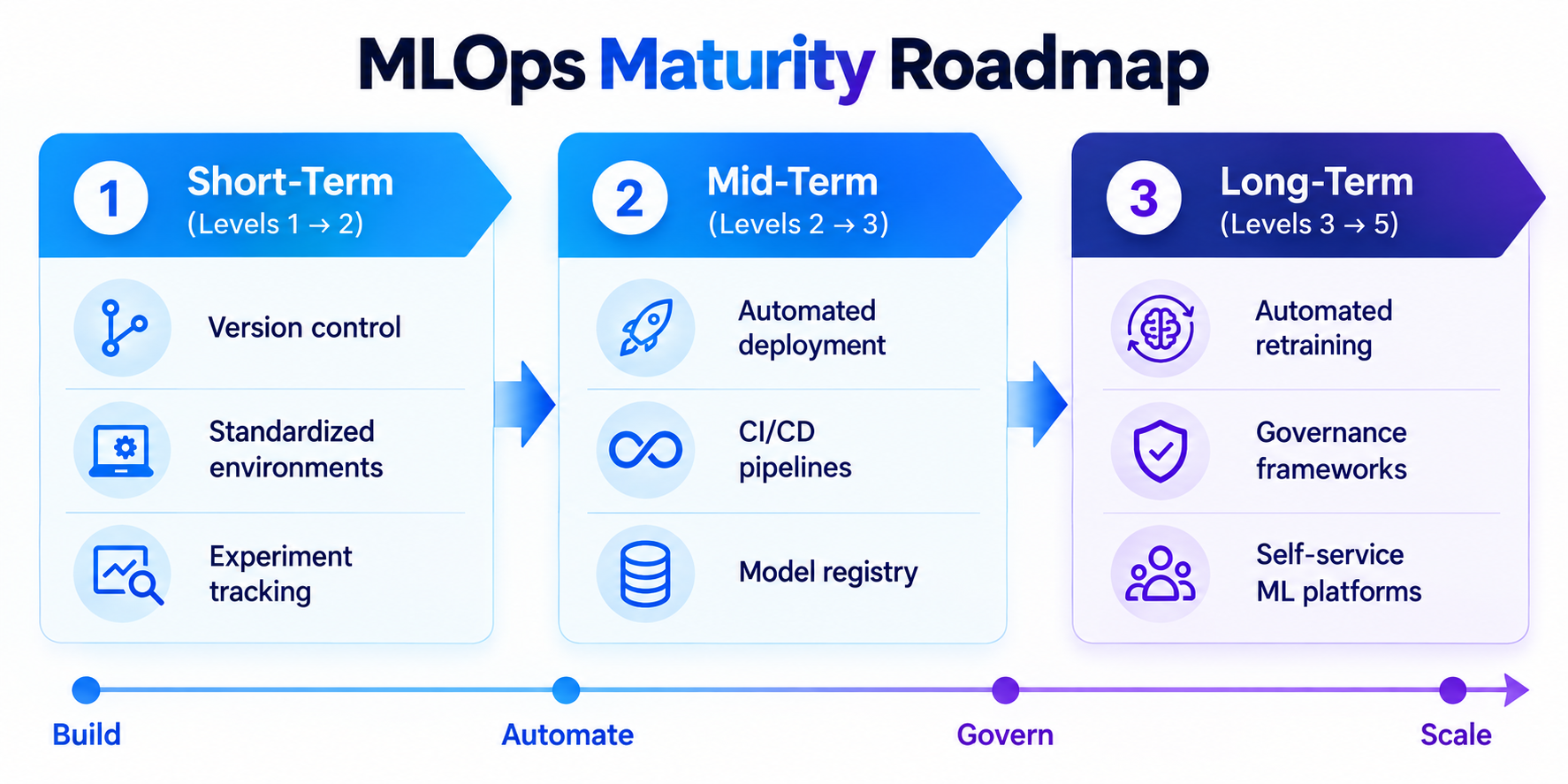
Improve MLOps maturity incrementally, delivering business value at each stage. The goal isn’t reaching Level 5 immediately, but progressing systematically. This week, pick one small process like experiment tracking and move it into version control. Small, consistent wins are the only way to climb the maturity ladder.
Short-Term Priorities (Levels 1 → 2)
• Implement version control for code and data
• Standardize development environments (Docker, conda)
• Introduce experiment tracking tools
Mid-Term Priorities (Levels 2 → 3)
• Automate model deployment with CI/CD pipelines
• Create centralized model registry
• Establish automated testing and validation gates
Long-Term Priorities (Levels 3 → 5)
• Enable automated retraining triggered by drift detection
• Implement enterprise governance and explainability frameworks
• Build self-service ML platforms for cross-functional teams
Conclusion
MLOps maturity is critical for determining whether machine learning initiatives can scale successfully. Organizations that invest in automation, governance, monitoring, and collaboration are better positioned to transform AI experiments into sustainable business outcomes. The key question isn’t whether your organization uses machine learning it’s whether you can reliably operationalize, monitor, and improve ML systems at scale. MLOps maturity is the bridge between AI experimentation and sustainable business value.