From Business Intelligence to Decision Intelligence
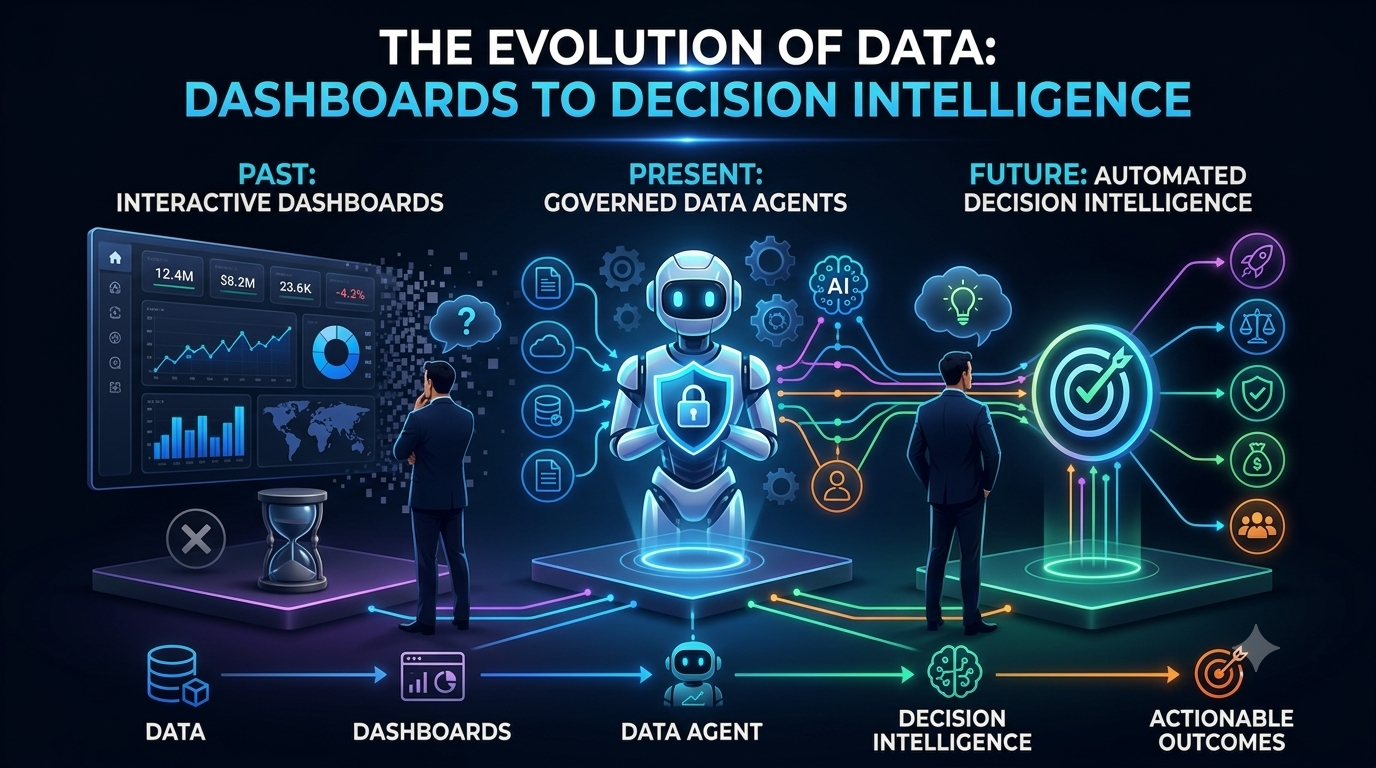
Table of Content
1. Why Interactive Dashboards Are No Longer Enough
2. The Success of Interactive Dashboards
3. The Four Problems Dashboards Never Solved
5. Executives Don’t Need Better Answers. They Need Better Decisions.
6. Decision Intelligence Is Not Just an LLM
7. Security Will Define the Next Generation of Enterprise AI
9. So, Are Interactive Dashboards Nearing Their End?
Why Interactive Dashboards Are No Longer Enough
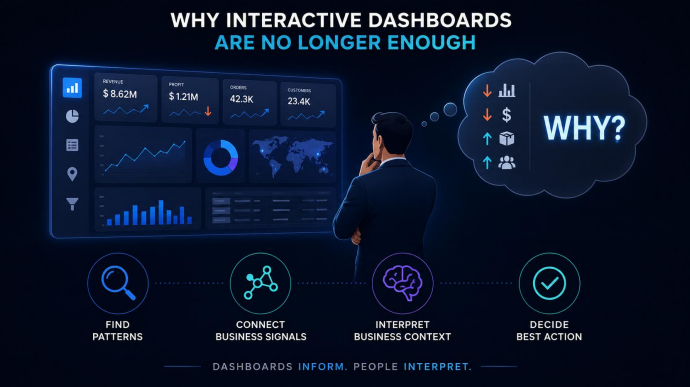
For more than three decades, Business Intelligence (BI) has been the foundation of data driven organisations.
We have evolved from static reports to interactive dashboards, self-service analytics, and most recently, conversational AI. Every generation has made data more accessible and reduced the dependency on technical teams.
Yet, despite investing millions in modern BI platforms, executives continue to ask a surprisingly simple question:
“What should we do?”
Ironically, this is the one question traditional Business Intelligence was never designed to answer. Business Intelligence excels at presenting information. Decision making is still left to humans.
As Artificial Intelligence matures, I believe we are witnessing the next major evolution of analytics—not the end of Business Intelligence, but its transformation into Decision Intelligence.
The Success of Interactive Dashboards
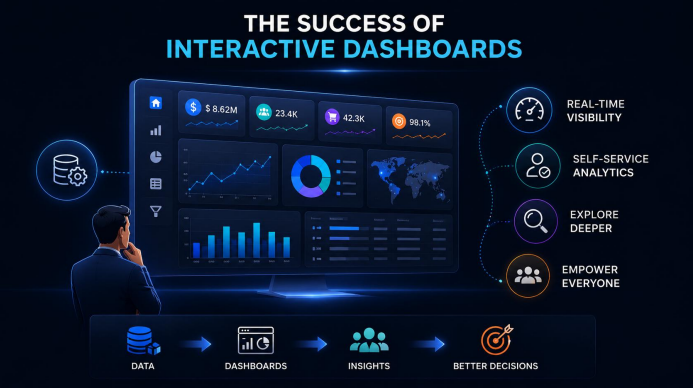
Interactive dashboards revolutionised analytics.
Instead of waiting days for reports, business users could explore data on demand.
They could filter, drill through, compare trends and analyse performance across multiple dimensions.
It was a remarkable leap from static reporting.
However, dashboards primarily solved one problem:
Access to Information.
They never fully solved the harder problem:
How do we transform information into confident business decisions?
The Four Problems Dashboards Never Solved
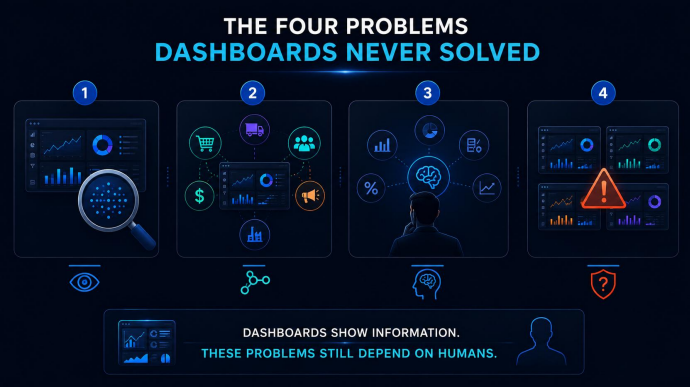
1. Humans Still Had to Discover Patterns
Dashboards visualize data.
They rarely explain why something happened.
When revenue suddenly declines or customer churn increases, the dashboard presents the numbers, but someone still needs to identify the underlying pattern.
The insight comes from the analyst—not the dashboard.
2. Humans Had to Correlate Multiple Business Factors
Business outcomes are rarely influenced by a single variable.
Sales performance may depend on pricing, marketing campaigns, inventory availability, customer behaviour, seasonality, supply chain performance and broader economic conditions.
Traditional dashboards display these variables independently.
Decision makers are expected to mentally connect them and determine which factors truly
matter.
3. Information Does Not Automatically Become Decisions
Executives don’t struggle because they lack reports.
They struggle because every important decision requires interpretation.
A typical executive review often involves:
- Opening multiple dashboards
- Comparing trends across different business functions
- Speaking with analysts
- Reconciling conflicting KPIs
- Preparing presentations
- Finally arriving at a recommendation
The dashboard provides evidence.
Humans provide judgement.
4. Multiple Dashboards Created Multiple Versions of Truth
One department reports revenue differently from another.
Finance calculates margin one way.
Sales uses another definition.
Marketing has its own customer metrics.
As organisations embraced self-service analytics, they also unintentionally created multiple versions of business truth.
Modern semantic models have significantly improved this challenge by introducing governed business definitions, but dashboards alone still don’t provide business reasoning.
The Arrival of Data Agents
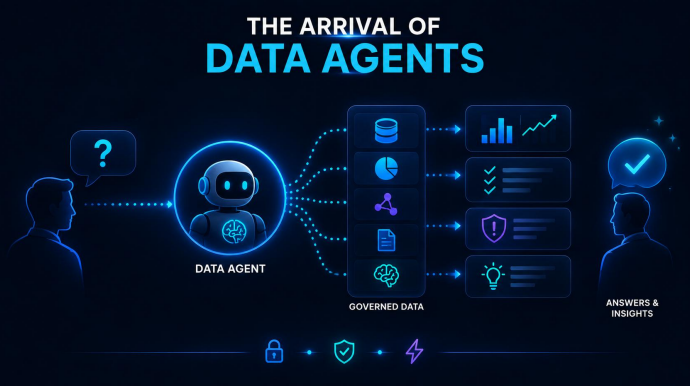
Generative AI introduced a fundamentally new way of interacting with enterprise data.
Instead of navigating dashboards, users simply ask questions in natural language.
What caused customer churn to increase?
Compare profitability across regions.
Which products underperformed this quarter?
Platforms such as Microsoft Fabric Data Agents combine semantic models and ontology to retrieve trusted business information while hiding the technical complexity from users.
This represents a major advancement in self-service analytics.
But answering questions is only one part of executive decision making.
Executives Don’t Need Better Answers. They Need Better Decisions.
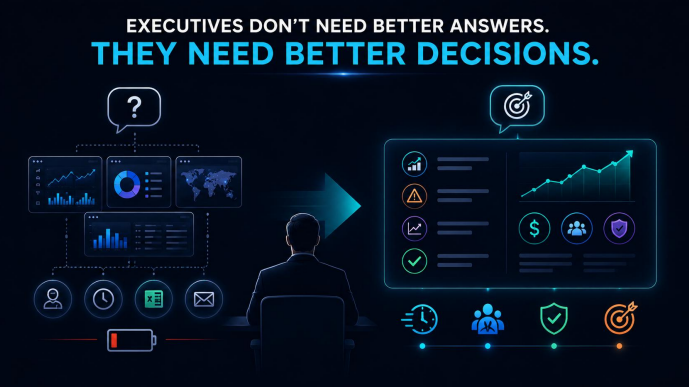
An executive preparing for a board meeting doesn’t want to spend an hour asking dozens of questions.
They need a concise, evidence-based briefing that explains:
- What changed?
- Why did it change?
- Which business drivers influenced the outcome?
- What risks are emerging?
- What opportunities exist?
- What actions should leadership consider?
This is fundamentally different from self-service analytics.
It is Decision Intelligence.
Rather than expecting leaders to explore data, Decision Intelligence analyses the data on their behalf and delivers a decision-ready narrative
Decision Intelligence Is Not Just an LLM
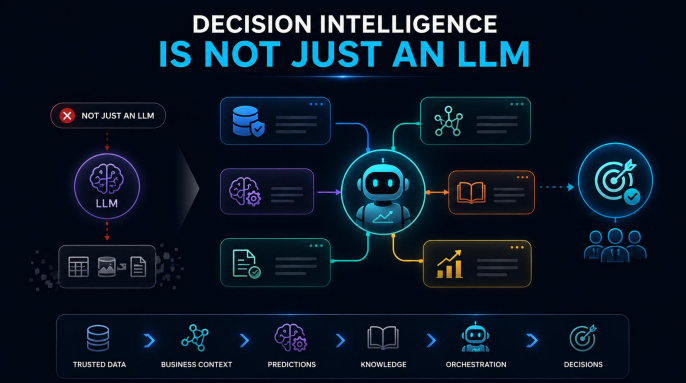
One of the biggest misconceptions surrounding Generative AI is the belief that an LLM alone can replace Business Intelligence.
It cannot.
Large Language Models excel at reasoning, summarisation and communication.
They are not calibrated prediction engines.
They do not inherently understand an organisation’s business model, operating policies, customer relationships or domain-specific definitions.
A robust Decision Intelligence platform requires several specialised capabilities working together.
A Governed Semantic Layer
Provides one trusted version of every KPI and business definition.
Enterprise Ontology
- Captures business relationships and organisational context.
- It understands how customers relate to products, suppliers, business units, contracts and organisational hierarchies.
- Without ontology, AI understands language. With ontology, AI understands the business.
- Enterprise Knowledge Base
- Policies.
- Operating procedures.
- Regulatory requirements.
- Historical reports.
- Business definitions.
These provide context that transactional data alone can never explain.
Machine Learning Models
Machine Learning identifies patterns hidden within enterprise data.
It predicts future outcomes such as customer churn, fraud, demand forecasting, equipment failure or cancellation risk.
Unlike an LLM, these models are trained, validated and calibrated using historical business data.
Their strength lies in prediction.
AI Agents
- AI Agents orchestrate the entire decision-making process.
- They retrieve trusted KPIs from semantic models.
- Invoke Machine Learning models.
- Consult enterprise knowledge.
- Understand business relationships through ontology.
- Reason across multiple sources of evidence.
- Generate executive narratives.
- Recommend actions.
- Initiate business workflows.
- Their role is not to replace analytics.
- Their role is to orchestrate intelligence.
This hybrid architecture where specialised ML models provide predictions while AI agents explain, recommend and coordinate actions is increasingly emerging as the most robust enterprise pattern.
Security Will Define the Next Generation of Enterprise AI
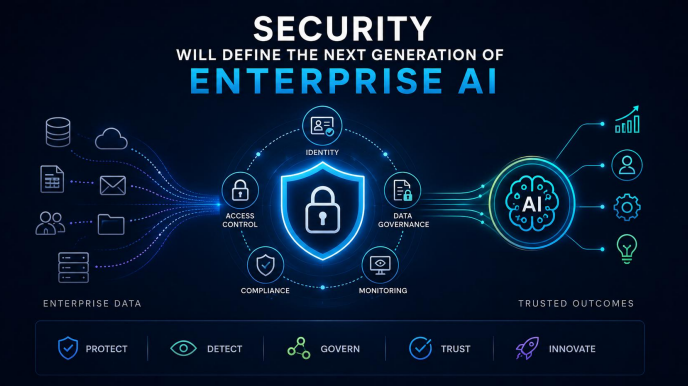
While most discussions focus on AI capabilities, enterprise adoption will ultimately depend on something far more important:
Trust
Many early AI implementations send large volumes of enterprise data directly to an LLM every time a question is asked.
This approach raises several concerns.
How much confidential business data leaves the enterprise boundary?
How is personally identifiable information protected?
How do organisations meet regulatory and compliance requirements?
More importantly, does an LLM really need to see millions of transactional records simply to recommend the next business action?
I believe the answer is no.
The future architecture of Decision Intelligence should minimise the amount of operational data exposed to language models.
Machine Learning models can analyse sensitive enterprise data securely within organisational boundaries to produce validated predictions such as churn probability, demand forecasts or fraud risk.
Semantic models provide governed business metrics.
Ontology provides business context.
Knowledge bases contribute organisational policies and historical knowledge.
The AI Agent orchestrates these specialised components.
The LLM receives trusted business intelligence—not raw operational data.
This approach strengthens security, improves governance, reduces unnecessary data exposure and produces recommendations that are both explainable and evidence-based.
The future of enterprise AI is not about sending more data to LLMs. It is about sending better intelligence.
The Evolution of Analytics
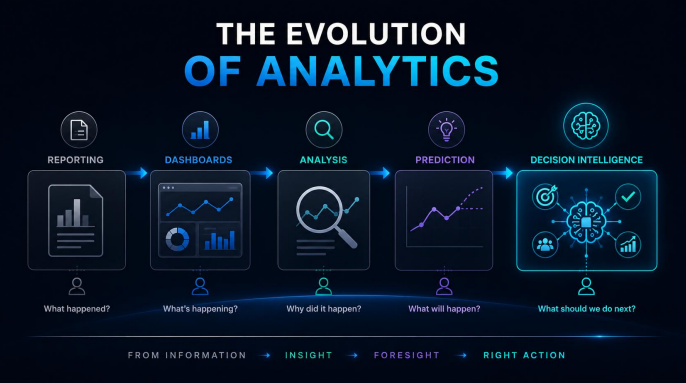
Looking back, analytics has evolved through four distinct generations.
Generation 1 – Static Reporting. “What happened?”
Generation 2 – Interactive Dashboards. “Let me explore the data.”
Generation 3 – Data Agents. “Ask me any business question.”
Generation 4 – Decision Intelligence. “I understand your business, analyse trusted data, predict likely outcomes and recommend the next best action.”
Each generation builds upon the previous one.
None of them disappear.
Their purpose simply evolves.
So, Are Interactive Dashboards Nearing Their End?
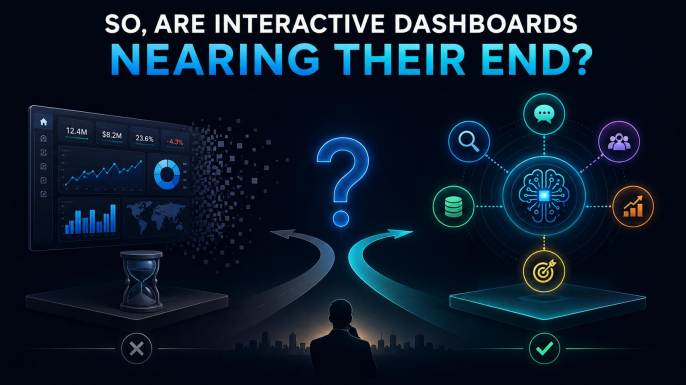
No. Interactive dashboards are too valuable to disappear.
They remain one of the most effective ways to explore data, validate insights and communicate business performance.
What is changing is their role ?
For the last twenty years, dashboards have been the primary interface between business users and enterprise data.
In the coming years, that role will increasingly shift to AI-powered Decision Intelligence Platforms.
Executives will begin with an AI-generated briefing, enriched by semantic models, ontology, machine learning, enterprise knowledge and governed business rules.
If deeper investigation is required, dashboards will remain available as supporting evidence.
The dashboards won’t disappear. It moves from the driver’s seat to the navigation system.
Final Thoughts
Business Intelligence transformed organisations by making data accessible.
Decision Intelligence will transform organisations by making decisions faster, more consistent and more explainable.
The future is not about replacing dashboards with chatbots.
It is about combining trusted enterprise data, semantic models, ontology, machine learning, enterprise knowledge and AI agents into a unified decision-making platform.
Interactive dashboards changed how we consumed information.
Decision Intelligence will change how organisations think.
And I believe that will be the next defining chapter in the evolution of Business Intelligence.
Blog Author

Maheshkumar Balshetwar
CTO
Intellify Solutions