dbt best practices for scalable data transformation at Enterprise scale
Table of Content
1. Why Enterprises Choose dbt for Transformations
3. Why Enterprises Choose dbt for Transformations
5. Enterprise Architecture Pattern for dbt
6. Scaling the Layered Approach with Domain-Oriented Project Organization
7. Enterprise Best Practices for dbt Transformations
8. Conclusion
The Enterprise Transformation Challenge
Over the last decade, enterprises have made significant investments in modern data platforms. Data ingestion has become easier through managed connectors, ELT platforms, streaming technologies, and cloud-native integration services. Data storage challenges have largely been addressed through scalable cloud data warehouses and lakehouses. Similarly, visualization and reporting have matured with modern BI platforms that enable rapid dashboard and self-service analytics development.
However, data transformation continues to be one of the most challenging aspects of the data lifecycle.
As organizations grow, transformation logic often becomes scattered across ETL tools, stored procedures, notebooks, SQL scripts, and custom applications developed by different teams over many years. What initially starts as a manageable solution gradually evolves into a complex ecosystem that is difficult to maintain, govern, and scale.
Common challenges observed across enterprise data platforms include:
- Thousands of SQL scripts distributed across multiple systems.
- Limited visibility into upstream and downstream dependencies.
- Duplicated business logic implemented by different teams.
- Difficult impact analysis when making changes.
- Slow onboarding of new data engineers and analytics engineers.
- Inconsistent KPI definitions across reports and business functions.
- Limited testing and validation capabilities.
- Manual deployment and release processes.
- Poor documentation and knowledge sharing.
These challenges directly impact data quality, development velocity, operational stability, and business trust in data.
To address these issues, organizations are increasingly adopting dbt (Data Build Tool). dbt introduces software engineering principles into analytics engineering by treating transformation logic as code. Through version control, modular development, automated testing, documentation, lineage tracking, and CI/CD integration, dbt enables data teams to build transformation frameworks that are scalable, maintainable, and enterprise-ready.
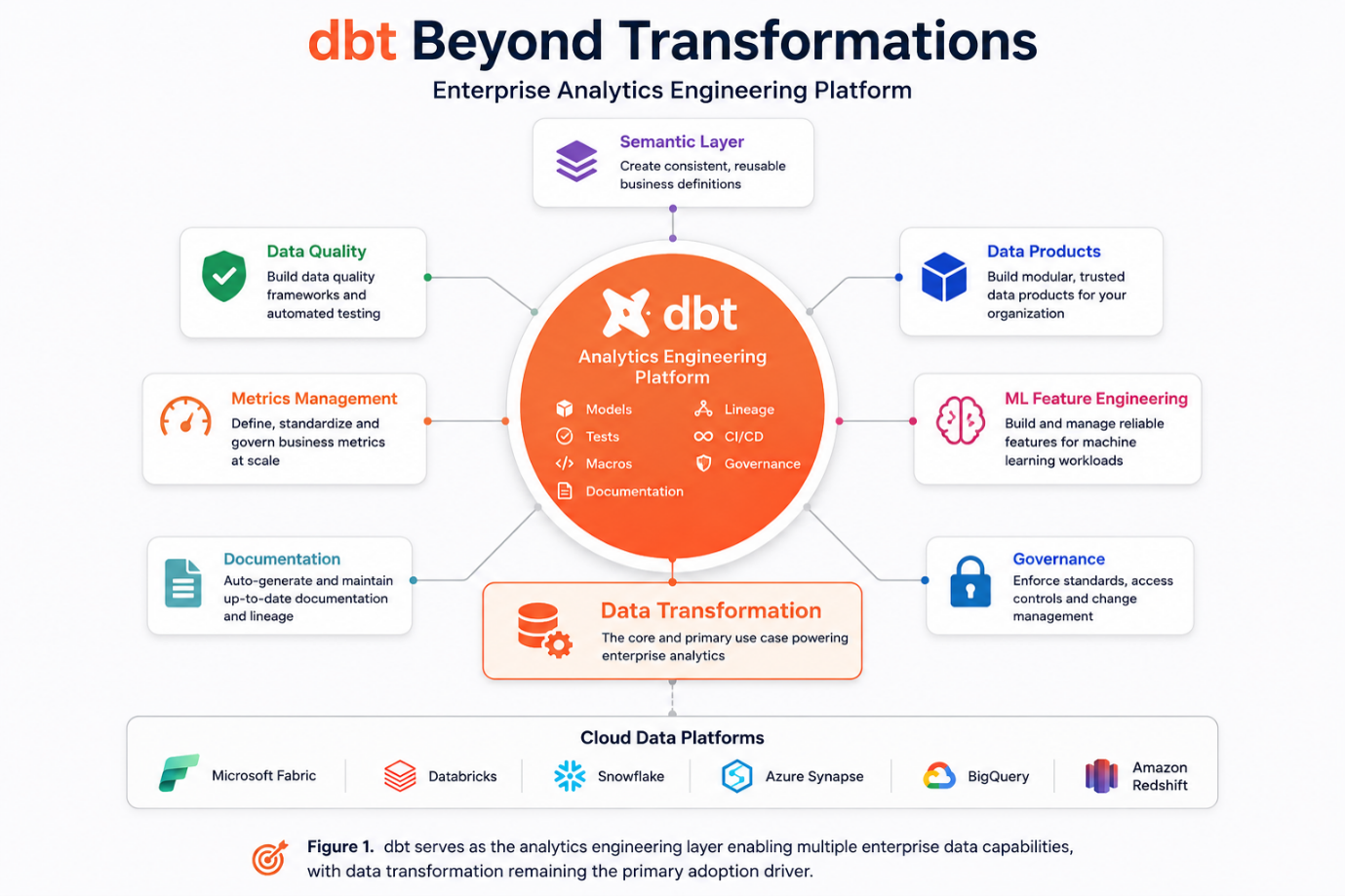
dbt Beyond Transformations (Quick Overview)
dbt is More Than Just Transformations
Although dbt is best known for SQL-based data transformations, its capabilities extend beyond transformation workloads.
Modern organizations use dbt for:
- Data quality testing
- Data documentation
- Data lineage visualization
- CI/CD for analytics
- Semantic layer management
- Metric governance
- Data contracts
- Analytics engineering workflows
However, the most mature and widely adopted use case remains enterprise-scale data transformation, which is the focus of this blog
Why Enterprises Choose dbt for Transformations
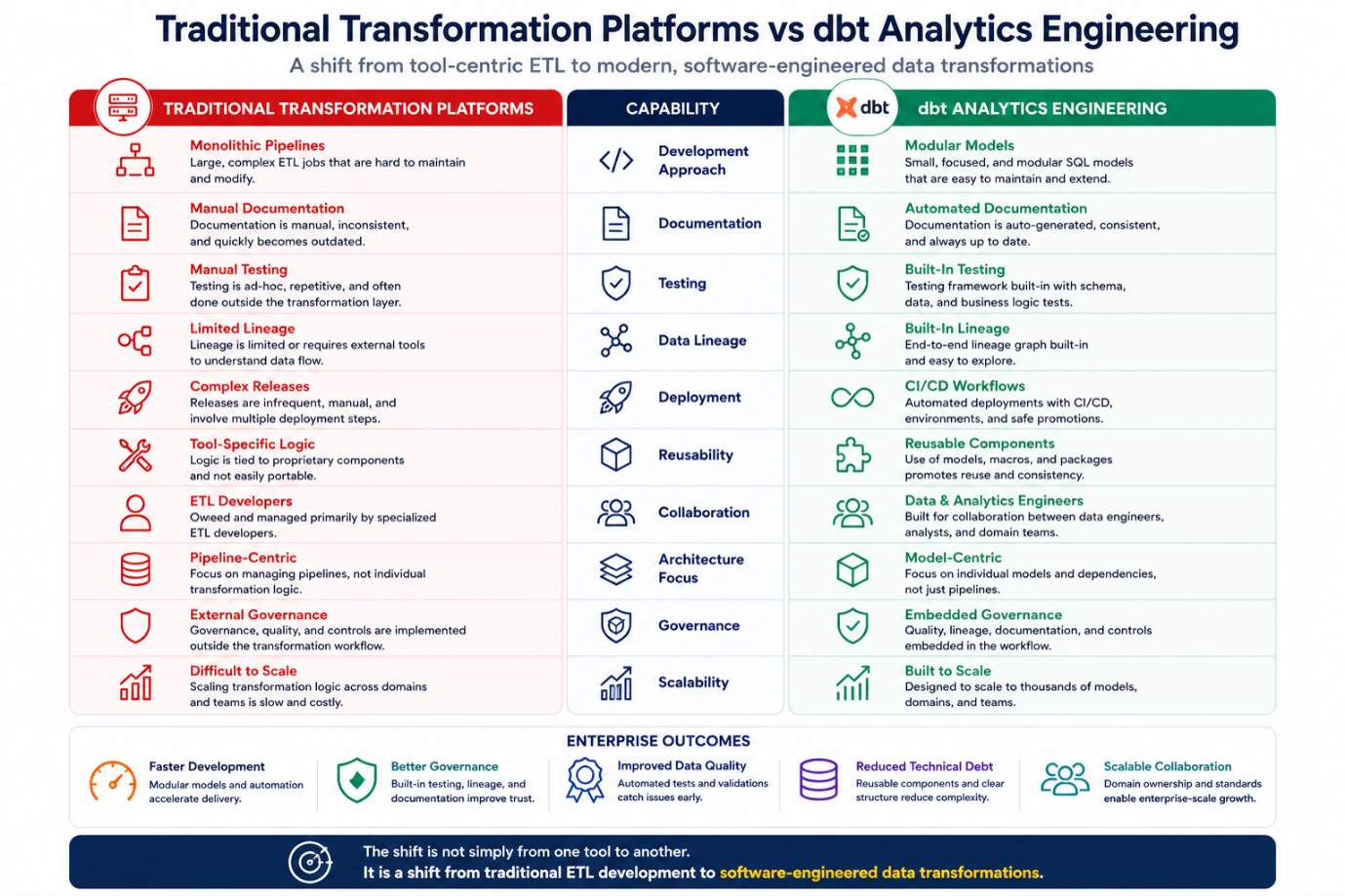
- Organizations rarely adopt dbt because it is another transformation tool. They adopt it because it solves many of the operational, governance, and scalability challenges that emerge as data platforms grow.By introducing software engineering practices into analytics engineering, dbt helps enterprises standardize how transformation logic is developed, tested, deployed, and maintained across the organization.
Standardization
Large enterprises often have multiple teams building transformations using different tools, coding standards, and deployment approaches. This creates inconsistencies in business logic, data quality, and operational processes.
dbt provides a common framework for developing and managing transformations across the organization.
Benefits:
- Consistent development standards.
- Common testing framework.
- Standardized deployment process.
- Shared project structure.
- Unified documentation approach.
Instead of every team solving the same problems differently, dbt enables a consistent transformation strategy across domains.
Modularity
As transformation workloads grow, maintaining large SQL scripts and monolithic ETL pipelines becomes increasingly difficult.
dbt promotes modular development through reusable models, macros, packages, and dependencies.
Benefits:
- Reusable transformation components.
- Reduced code duplication.
- Easier maintenance.
- Faster development cycles.
- Improved readability.
Teams can build once and reuse logic across multiple projects rather than repeatedly implementing the same business rules.
Governance
Governance becomes a critical requirement as more business users depend on analytical datasets.
dbt provides several built-in capabilities that strengthen governance across the transformation layer.
Key capabilities:
- Automated testing.
- Data lineage visualization.
- Documentation generation.
- Version control integration.
- Change tracking.
- CI/CD support.
- Environment isolation.
These capabilities improve trust, auditability, and operational control across enterprise data platforms.
Scalability
Many organizations begin with a small number of transformations but eventually manage hundreds or thousands of models across multiple business domains.
dbt is designed to scale with growing transformation ecosystems.
Benefits:
- Domain-based project organization.
- Dependency management.
- Large-scale model orchestration.
- Multi-team collaboration.
- Support for thousands of transformation models.
- Enterprise deployment workflows.
This allows organizations to expand transformation capabilities without creating unmanageable technical debt.
Summary
dbt’s enterprise adoption is driven by five fundamental capabilities:
- Standardization across teams.
- Modular and reusable development.
- Strong governance controls.
- Scalability across domains and workloads.
- Cloud-native execution on modern data platforms.
Together, these capabilities make dbt one of the most widely adopted frameworks for enterprise-scale data transformations.
This capability eliminates repetitive work and ensures consistency of business logic across reports.
4. Choose a mode: Quick Prototype, Interpretable, Best Fit or Custom.
Enterprise Architecture Pattern for dbt
The Layered Transformation Approach
As dbt adoption grows across the enterprise, one of the most important architectural decisions is how transformation logic is organized. While small projects can often operate with a flat model structure, enterprise-scale implementations require a clear architectural pattern that promotes scalability, maintainability, governance, and collaboration.
A widely adopted approach is the Medallion Architecture, which organizes transformations into logical layers that progressively improve data quality and business value as data moves through the platform.
Rather than creating large, monolithic transformation pipelines, the Medallion approach encourages data teams to separate concerns and build transformations incrementally through clearly defined stages.
Why This Pattern Works for Enterprise dbt Projects
The Medallion architecture aligns naturally with dbt’s modular development model.
Benefits include:
|
|
Most importantly, the layered approach prevents business logic from becoming tightly coupled across the transformation ecosystem, allowing organizations to scale hundreds or thousands of models without creating unmanageable dependencies.
Scaling the Layered Approach with Domain-Oriented Project Organization
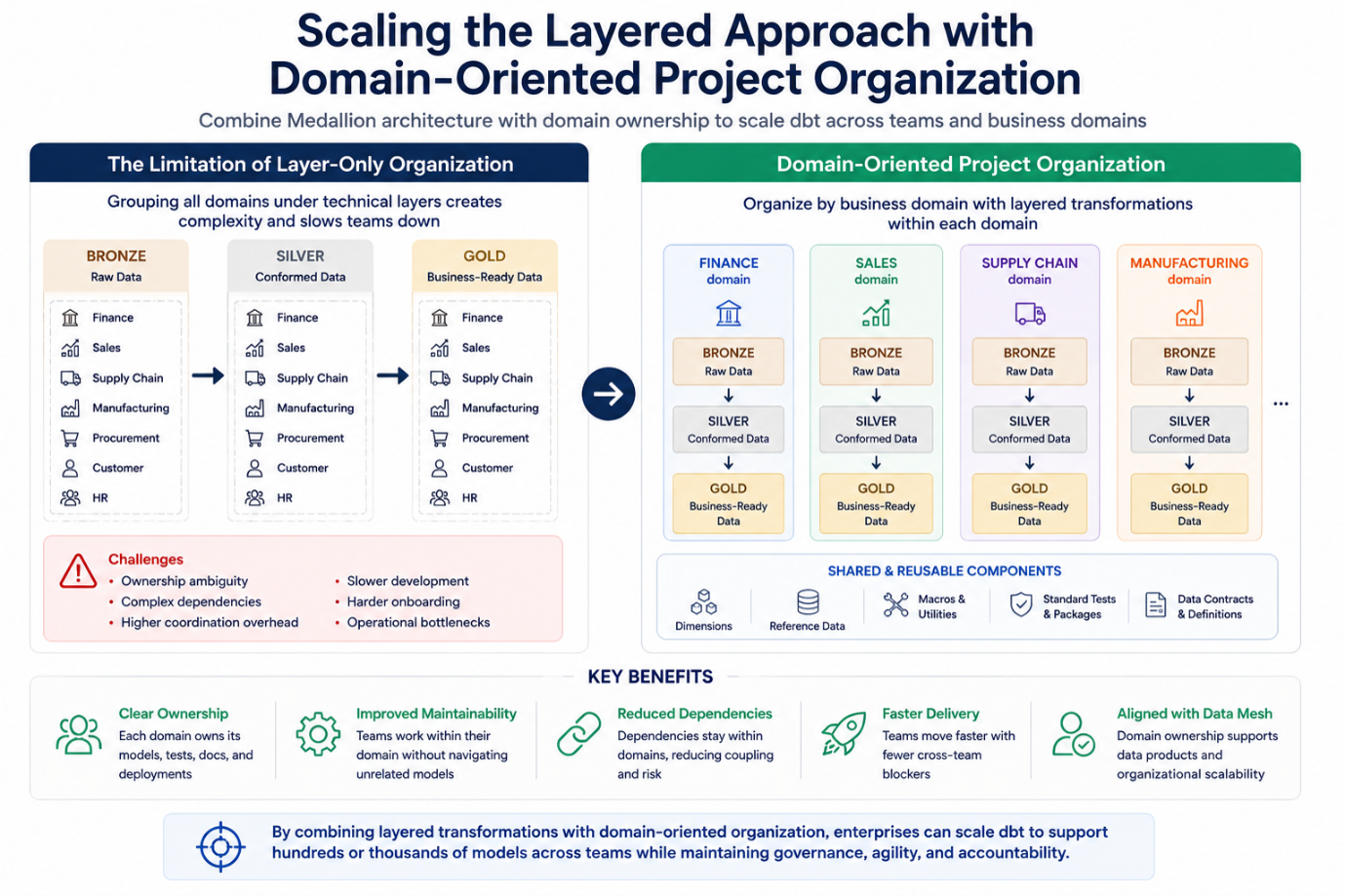
While the Medallion architecture provides an effective framework for managing transformation stages, enterprise-scale dbt implementations require an additional organizational strategy. As the number of business domains, engineering teams, and transformation models grows, organizing projects solely around Bronze, Silver, and Gold layers can create ownership ambiguity, complex dependencies, and operational bottlenecks.
To address this challenge, leading organizations combine layered architecture with domain-oriented ownership. Instead of grouping models exclusively by transformation stage, assets are organized around business domains such as Finance, Sales, Supply Chain, and Manufacturing. This approach establishes clear ownership boundaries, improves maintainability, reduces cross-team dependencies, and enables organizations to scale transformation platforms across hundreds or thousands of models while maintaining governance, agility, and accountability.
Enterprise Best Practices for dbt Transformations
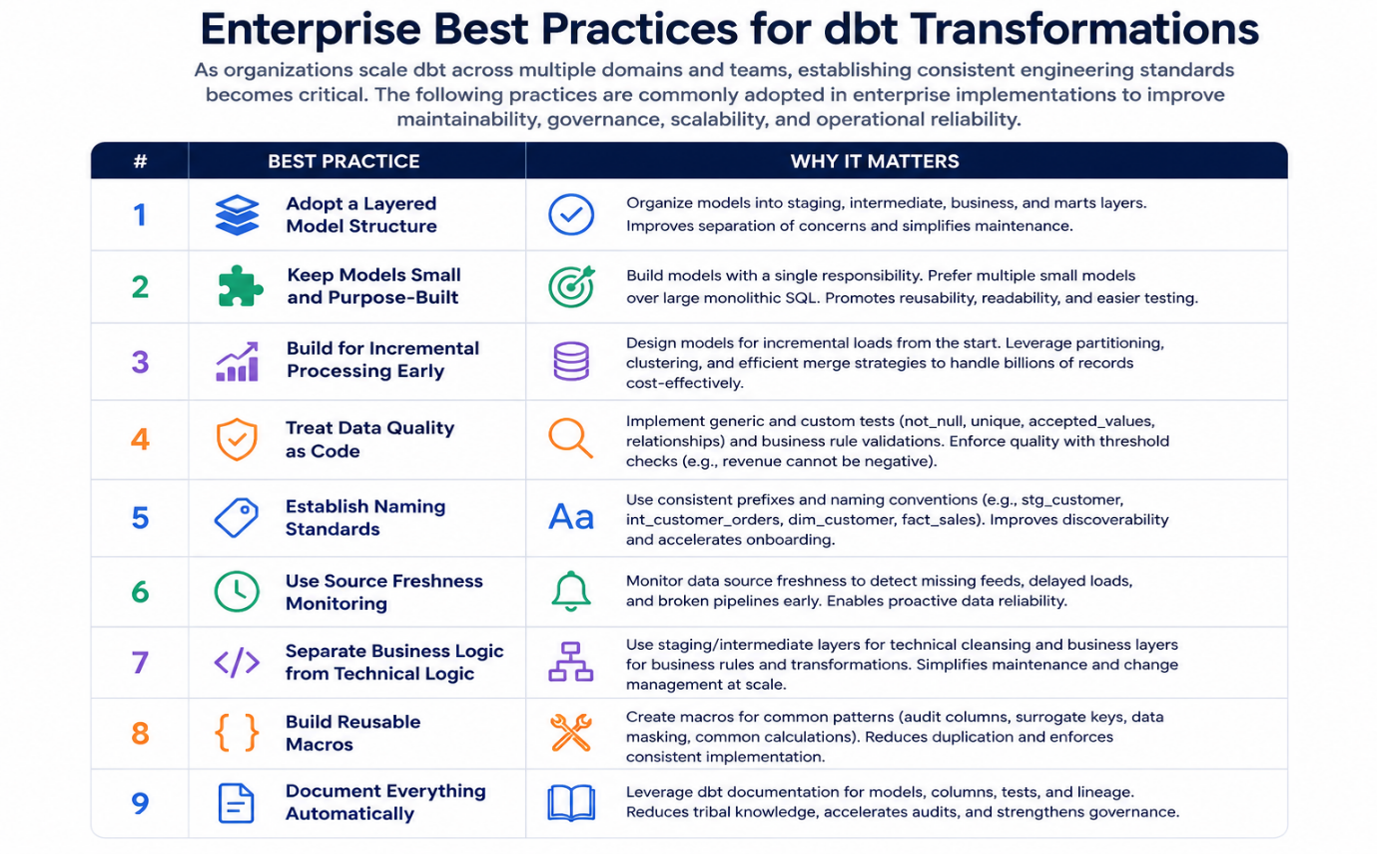
As organizations scale dbt across multiple domains and teams, establishing consistent engineering standards becomes critical. The following practices are commonly adopted in enterprise implementations to improve maintainability, governance, scalability, and operational reliability.
Conclusion
As enterprise data platforms continue to grow in scale and complexity, data transformation remains one of the most critical and challenging components of the modern data lifecycle. While organizations have largely standardized data ingestion, storage, and visualization, transformation often becomes the layer where technical debt, governance challenges, and operational inefficiencies accumulate.
dbt addresses these challenges by bringing software engineering principles to analytics engineering. Through modular development, testing, documentation, lineage, and governance capabilities, dbt enables organizations to build transformation frameworks that are scalable, maintainable, and easier to operate at enterprise scale.
However, technology alone is not enough. Successful enterprise implementations require thoughtful architectural decisions, including layered transformation patterns, domain-oriented ownership, and consistent engineering standards. When combined with proven best practices, these approaches help organizations scale transformation workloads across teams and business domains while maintaining reliability, governance, and agility.
For enterprises looking to modernize their transformation layer, dbt is more than a transformation tool—it is a foundation for building trusted, governed, and scalable data products that can support long-term business growth.
Blog Author

Shubham Kakade
Data Engineer
Intellify Solutions